

Ballantyne office towers, medical suites along Ballantyne Commons Parkway, and the storefronts lining Johnston Road all operate under one shared reality: the property, the lease, and the client relationships at stake are valuable, and a generic policy rarely matches the exposure. Business insurance in Ballantyne, North Carolina must reflect the expectations of corporate landlords, the regulatory obligations of licensed professionals, and the daily foot traffic of a busy retail corridor.
South Charlotte has continued to attract headquarters relocations, financial services firms, and healthcare groups, and the commercial real estate market has responded. Charlotte's office vacancy rate improved to 18.5% in Q3 2026, down from a 2025 peak of nearly 26%, and net absorption reached 456,000 square feet, marking four consecutive quarters of gains. More occupied suites mean more leases, more certificate requests, and more business owners asking whether their current coverage actually satisfies what they signed.
The guidance below addresses office tenants, professional firms, medical practices, and retailers, with attention to the North Carolina rules and market conditions that shape each decision in 2026.
Navigating Ballantyne North Carolina Business Insurance Needs
Businesses along the Johnston Road corridor and within Ballantyne's corporate parks need tailored coverage because property values, tenant improvements, and lease obligations are higher than average. Landlords typically dictate minimum liability limits, additional insured wording, and waiver requirements, so a policy must be built around the lease rather than purchased off the shelf.
The most frequent problem observed in this submarket is not a lack of insurance but a mismatch between insurance and contract. A firm signs a ten-year lease in a Class A building, the lease requires $2 million in aggregate general liability with the landlord named as an additional insured on a primary and noncontributory basis, and the existing business owner's policy carries $1 million with no such endorsement. The gap is often discovered only when the property manager rejects a certificate or, worse, after a claim.
Tenant improvements present a second overlooked exposure. When a business pays for build-out work such as custom millwork, glass conference rooms, or exam room cabinetry, those improvements frequently belong to the tenant for insurance purposes until the lease ends. If a sprinkler discharge damages the suite, the building owner's policy may cover the structure while the tenant's own policy is expected to cover the improvements and betterments.
Market conditions also matter. The North Carolina property and casualty market posted 4.3% overall premium growth in late 2026, a signal of more moderate pricing than in prior years. That environment gives Ballantyne business owners a reasonable window to restructure coverage around lease terms rather than simply renewing what was purchased years ago.
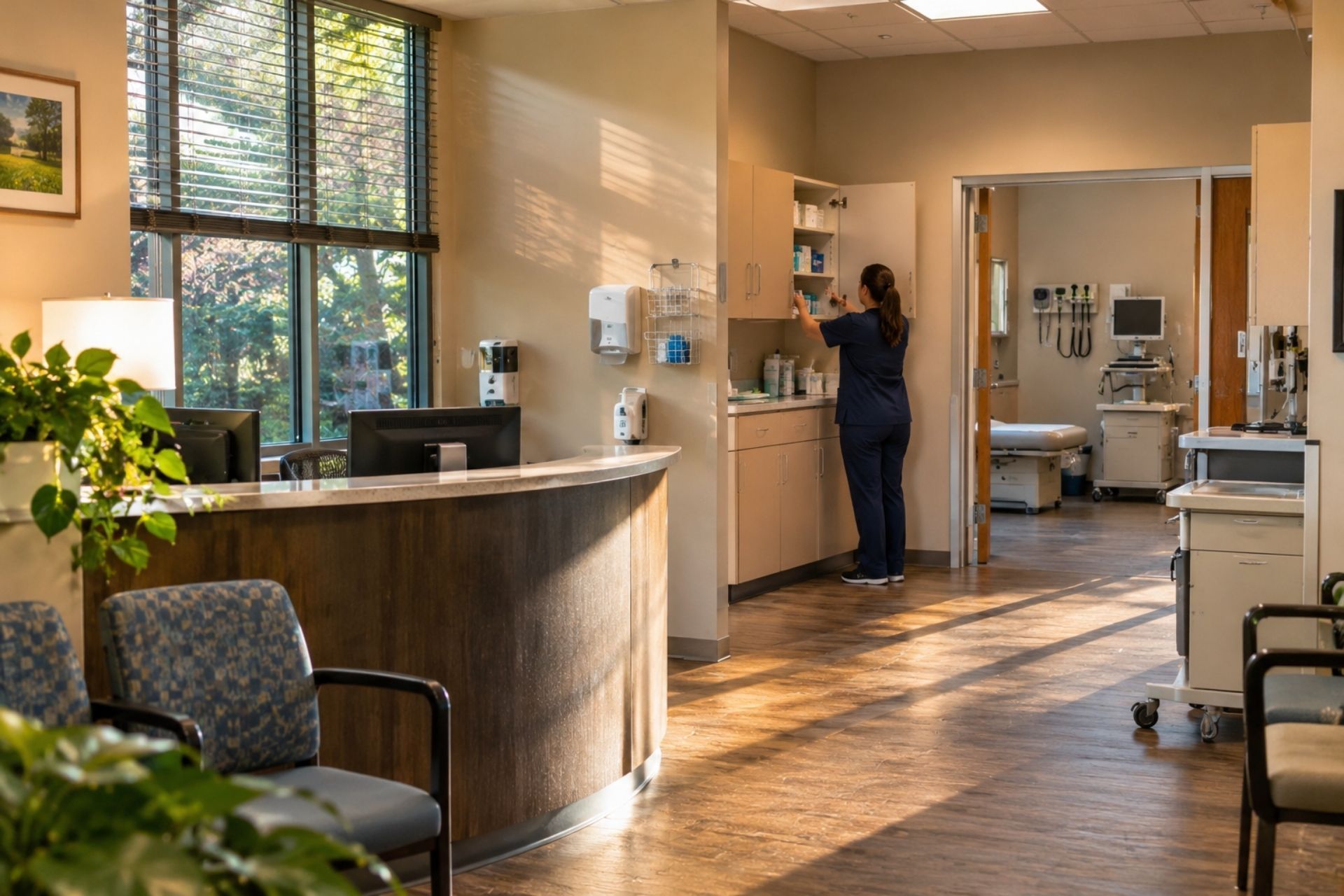
Insurance for Professional and Medical Offices in Ballantyne
Professional firms and medical practices in Ballantyne require professional liability and data breach coverage in addition to a standard business owner's policy. Carriers such as Erie, Travelers, and Cincinnati offer business owner's programs that may be paired with cyber and professional endorsements, while specialty markets typically address malpractice.
Accounting firms, law offices, engineering consultancies, financial advisors, and insurance-adjacent businesses in the Ballantyne corporate parks share one primary exposure: the allegation that advice or services caused a client financial harm. A missed tax filing deadline, an incorrect structural calculation, or a delayed regulatory submission can produce a claim that a general liability policy will not touch, because general liability is designed around bodily injury and property damage rather than financial loss from professional work.
Medical and dental practices face a broader set of exposures. A practical framework recommended for healthcare offices involves combining three to five carriers to cover six core lines: malpractice, a business owner's policy, workers compensation, cyber coverage addressing HIPAA obligations, employment practices liability, and an umbrella. Medical professional liability rates saw a modest average increase of 1.8% at midyear 2026, and North Carolina physicians also gained a new option when the North Carolina Medical Society launched InsureHaven in October 2026, a partnership providing P&C and malpractice solutions for North Carolina-based physicians.
Cyber coverage deserves particular attention. A ransomware event that locks an electronic health records system can trigger patient notification costs, forensic investigation, regulatory defense, and lost revenue simultaneously. Depending on the carrier, cyber protection may be available as an endorsement to a business owner's policy with Erie, Travelers, or Cincinnati, or as a standalone policy with broader limits.
Professional Liability vs General Liability Comparison
Confusion between these two coverages remains one of the most common errors among new Ballantyne tenants, and the distinction is summarized below.
| Feature | General Liability | Professional Liability |
|---|---|---|
| Covers | Bodily injury, property damage, advertising injury | Financial loss from errors, omissions, negligent advice |
| Typical claim | Client trips in the lobby of the suite | Client alleges a missed filing cost them money |
| Policy trigger | Usually occurrence-based | Usually claims-made |
| Lease requirement | Almost always required | Rarely required by landlords |
| Who needs it | Nearly every business | Advisors, consultants, medical and licensed professionals |
The claims-made structure of professional liability creates a specific risk: if a policy lapses or a firm switches carriers without preserving its retroactive date, claims arising from earlier work may be uncovered. Retroactive dates should be confirmed at every renewal.
Protecting Retail Businesses Along the Johnston Road Corridor
Retailers along Johnston Road face inventory, customer injury, and business interruption risks driven by steady foot traffic and seasonal stock levels. Coverage should address slip-and-fall liability, theft, spoilage where applicable, and income loss, while wind and hail deductibles are rarely used in the Charlotte area.
Boutiques, restaurants, salons, fitness studios, and specialty shops in the shopping centers along this corridor serve a dense residential population, and that customer volume drives the most frequent claim type: premises liability. A customer slipping on a rain-soaked entry mat, tripping over a display fixture, or being struck by merchandise falling from a shelf represents the classic general liability claim. Medical payments coverage, often included in a business owner's policy, can resolve minor injuries quickly without a lawsuit.
Inventory protection requires closer review than most retailers expect. Stock levels fluctuate considerably, and a store carrying twice its normal inventory between November and January may be underinsured if the business personal property limit reflects only an average month. A peak season endorsement, available from some carriers, temporarily increases limits during high-inventory periods.
Retailers should also consider these exposures:
- Crime and employee dishonesty: Covers theft by employees, which property policies frequently exclude.
- Equipment breakdown: Responds when refrigeration, point-of-sale systems, or HVAC units fail mechanically.
- Spoilage: Important for food service and specialty grocery tenants.
- Signage: Exterior signs are sometimes limited or excluded unless scheduled.
On deductibles, Charlotte-area retailers generally carry a standard all-perils deductible. Separate percentage-based wind and hail deductibles are mainly a coastal North Carolina issue and are rarely applied to properties in this part of Mecklenburg County, so a quote containing one should prompt a question.

Understanding Ballantyne Corporate Park Lease Insurance Requirements
Property managers in Ballantyne often require specific minimum limits for general liability and workers compensation, along with additional insured status for the landlord. Compliance must be documented through a Certificate of Insurance, and many managers verify certificates annually before renewal.
A typical Class A lease in the Ballantyne corporate parks contains an insurance exhibit that reads more like a specification sheet than a suggestion. It will commonly list a per-occurrence and aggregate limit for general liability, a requirement for workers compensation at statutory limits with stated employer's liability limits, umbrella coverage above the primary layers, and property coverage on the tenant's contents and improvements. Many leases also require a waiver of subrogation, which prevents the tenant's carrier from pursuing the landlord after paying a claim.
The Certificate of Insurance is the document that proves compliance, but it is only a summary. A certificate stating that the landlord is an additional insured carries no weight unless the policy itself contains the corresponding endorsement. Property managers increasingly request copies of the endorsements alongside the certificate, and lenders financing the building sometimes impose their own requirements on tenants.
A practical process for lease compliance follows:
- Send the full insurance exhibit to an agent before signing, not after.
- Compare required limits against current policy limits line by line.
- Confirm the exact legal names of the landlord, management company, and lender for additional insured wording.
- Request primary and noncontributory and waiver of subrogation endorsements where required.
- Calendar certificate renewals so the property manager receives updates before expiration.
Lease negotiations occasionally allow adjustments. A small professional office may be able to request lower umbrella limits than a high-traffic retail tenant, particularly while Charlotte vacancy remains elevated.
Core Coverages for North Carolina Business Owners
Most North Carolina business owners need property, general liability, workers compensation, and commercial auto coverage at minimum. Firms operating vehicles or small fleets often place commercial auto with carriers such as Progressive or National General, while umbrella policies extend liability limits above the primary layers.
The foundation of most small and midsize business programs in Ballantyne is the business owner's policy, which bundles property and general liability at a typically efficient price point. From there, coverage expands based on operations:
- Commercial property: Protects furniture, computers, inventory, and tenant improvements against fire, theft, water damage, and other covered perils.
- General liability: Responds to third-party bodily injury, property damage, and advertising injury claims.
- Business income: Replaces lost revenue and covers continuing expenses after a covered property loss forces a closure.
- Commercial auto: Required for vehicles titled to the business. Progressive and National General are frequently used for contractors, delivery operations, and fleet needs, with program features varying by carrier.
- Hired and non-owned auto: Protects the business when employees drive personal vehicles on company errands, a common exposure for professional firms whose staff visit clients.
- Employment practices liability: Covers wrongful termination, discrimination, and harassment allegations.
Group health benefits, while outside property and casualty coverage, also affect budgeting. The North Carolina Department of Insurance approved premium increases between 18.78% and 19.54% for small group health policies for the 2027 plan year. Owners of non-owner-occupied investment properties should also note that North Carolina dwelling rates increased by a statewide average of 5% on October 1, 2026, with another 5% scheduled for October 1, 2027.
Workers Compensation Requirements in North Carolina
North Carolina generally requires workers compensation once a business regularly employs three or more people, including part-time staff, with stricter thresholds applying to certain industries. Many Ballantyne leases require statutory coverage regardless of headcount, so a two-person firm may still need a policy to satisfy its landlord.
Benefit levels are set by the state. The maximum weekly compensation rate for 2026 is $1,446.00, and injured workers generally have two years to file an initial claim for injury by accident under N.C.G.S. § 97-24. Office injuries are more common than many owners assume, including repetitive strain, falls in parking decks, and lifting injuries in medical supply rooms.
Commercial Umbrella and Excess Liability Layers
An umbrella policy sits above general liability, employer's liability, and commercial auto, adding limits once the underlying policies are exhausted. A single serious auto accident involving an employee or a severe customer injury can exceed a $1 million primary limit quickly, and many Ballantyne leases specify umbrella minimums. Underlying limits must match the umbrella carrier's requirements, or a gap may appear between layers.
Frequently Asked Questions About Ballantyne Insurance
The questions below reflect the concerns most commonly raised by Ballantyne tenants, professionals, and retailers. Each answer is intentionally brief, and specific situations should be reviewed against actual lease language and policy wording before any coverage decision is made.
How much coverage does my lease require?
The answer appears in the insurance exhibit of the lease, which typically lists minimum general liability, umbrella, and workers compensation limits. An agent can compare those requirements against an existing policy before the lease is signed.
Do I need workers comp if I only have two employees?
North Carolina generally does not require workers compensation for most businesses with fewer than three employees. However, a landlord or client contract may still require it, and coverage protects the owner from uninsured injury costs.
Does my business owner's policy cover a data breach?
Often only partially or not at all. Cyber coverage usually must be added by endorsement or purchased separately, which is especially important for medical offices handling patient records.
Will my landlord's building insurance cover my equipment?
Generally no. The landlord's policy typically covers the structure, while the tenant is responsible for its own furniture, computers, inventory, and often its improvements.
Do I need professional liability if my clients never visit my office?
Yes, in most cases. Professional liability addresses claims arising from advice and services, which have nothing to do with whether clients ever enter the suite.
Are wind and hail deductibles common in Charlotte?
No. Those separate deductibles are mainly a coastal North Carolina issue and are rarely used for Charlotte-area commercial properties.
Key Differences in Business Insurance Policies
Two policies with identical premiums can respond very differently after a loss. Basic forms limit covered causes and payout methods, while extended forms broaden protection for office equipment and business interruption, which is often decisive for Ballantyne firms dependent on technology and continuous operations.
The following comparison illustrates common distinctions, although exact terms vary by carrier and form.
| Coverage Area | Basic Option | Extended Option |
|---|---|---|
| Office equipment valuation | Actual cash value (depreciation deducted) | Replacement cost |
| Covered causes | Named perils only | Special form (all risks unless excluded) |
| Off-premises equipment | Limited or excluded | Laptops and devices covered while traveling |
| Business income period | Limited restoration period | Extended period of indemnity after reopening |
| Utility interruption | Often excluded | Off-premises power outage coverage |
| Data restoration | Minimal or none | Sublimit for restoring electronic records |
The valuation difference is frequently the most consequential. A four-year-old server and workstation network destroyed by a water loss may receive a fraction of replacement value under actual cash value terms, leaving the firm to fund new equipment out of pocket.
Business interruption terms also deserve scrutiny. A medical practice that reopens after repairs often does not return to full patient volume immediately, and an extended period of indemnity continues paying for the revenue shortfall during that ramp-up period rather than stopping the day the doors reopen.
Choosing the Right Carrier for Your Ballantyne Business
An independent agency compares multiple carriers on a single business, matching each line of coverage to the market most suited to it. For Ballantyne firms, that approach typically produces stronger lease compliance and broader protection than relying on one company for every exposure.
A captive agent represents one company and can offer only that company's products. An independent agency evaluates several carriers, which matters considerably for businesses whose exposures span multiple lines. A medical practice may find its business owner's policy fits well with one carrier, its workers compensation with another, and its commercial auto with a third. North Carolina's insurance market depth reflects this variety, extending even to captive insurers, with 21 new captive insurance companies licensed in the state in the most recent reporting year.
O'Connor Insurance Associates works with a range of carriers for Ballantyne businesses, including:
- Erie: Often considered for business owner's policies serving offices and professional firms.
- Travelers: Frequently used for middle-market accounts, property, and specialty endorsements.
- Cincinnati: May suit professional and commercial accounts seeking package flexibility.
- Progressive: Commonly placed for commercial auto and small fleets.
- National General: Another option for commercial auto and fleet needs.
- Utica: Can fit select commercial accounts depending on class of business.
- Foremost: Often considered for owners of rental and investment properties.
Coverage features, eligibility, and pricing vary by carrier and are subject to underwriting. The agency places policies with these carriers but does not itself issue coverage, and its role centers on asking detailed questions, explaining policy differences, and designing a program around each business rather than defaulting to a single template.
Making the Right Choice for Your Protection
The right business insurance program for a Ballantyne company aligns with its lease, its professional obligations, and its actual operations. A coverage review before signing a lease or renewing a policy is the most reliable way to close gaps before a claim exposes them.
Each type of business along this corridor carries a distinct profile. Corporate park tenants must satisfy detailed lease exhibits verified through certificates and endorsements. Professional firms and medical practices need professional liability and cyber protection that general liability cannot provide. Retailers along Johnston Road depend on accurate inventory limits and dependable premises liability coverage. Insurance remains the safety net for the disaster no one planned for, and in a market with moderating rate growth, 2026 presents a practical moment to rebuild that net properly.
O'Connor Insurance Associates, an independent agency serving Charlotte, North Carolina since 2000, assists Ballantyne business owners with lease reviews, carrier comparisons, and coverage design. O'Connor Insurance Associates is a licensed North Carolina insurance agency (license #7014004).
To schedule a review of current coverage or lease insurance requirements, contact O'Connor Insurance Associates at 704-510-8884, or visit the office at 1973 JN Pease Place, Suite 203, Charlotte, NC 28262. Bringing a copy of the lease insurance exhibit and current declarations pages to the first conversation allows the review to begin with specifics rather than estimates.
Last updated:
On this page
O’Connor Insurance Associates is fully licensed to provide personal and commercial insurance solutions for individuals, families and businesses across North Carolina.
We proudly serve families and business owners from our office in Charlotte, North Carolina. As an independent, family-owned agency since 2000, our team works with more than one insurance company to make sure homeowners, drivers, contractors, landscapers, small businesses and other personal and commercial clients receive coverage that fits their real risks.

About the Author
President & Founder
I’m Terry O’Connor, President and Founder of O’Connor Insurance Associates. I grew up in Pennsylvania, earned my bachelor’s degree at Edinboro University and my master’s at Gannon University, and in 1998 I traded snow for sunshine and moved to Charlotte. In January 2000, I started this agency on my own because I wanted to help people protect what matters most to them. More than two decades later, we’ve grown into an independent agency serving families and businesses across North Carolina, and we’ve been recognized as an IIABA Best Practices Agency every year since 2010, a distinction held by fewer than 1% of agencies nationwide.
I’ve seen firsthand how the right protection can change a family’s or a business owner’s life, and that’s why I lead with empathy, education and honest advice. As an independent agent, I work for you, not for one insurance company. I take the time to explain your options in plain language, and when you call our office, you reach a real person who knows your account.
Outside the office, you’ll usually find me outdoors hunting or fishing, or on the mat coaching wrestling as an assistant varsity coach at Mallard Creek High School. I’m also a proud supporter of the arts, usually in the front row cheering on my daughter in local theater productions. I’d be glad to review your coverage with you. Call me at 704-510-8884 or email terry@oianc.com.
Relationships are the real measure
What our North Carolina clients say.
5.0 / 5
185 reviews on Google
Personal insurance
For the life you’re making.
Your home, your car, your time away. Let’s look at the whole picture.
Business insurance
For the business you’re building.
From established local companies to growing teams, we help make the coverage conversation clearer.
Your work deserves a closer look
Different businesses.
Different conversations.
We take time to understand what happens in your business every day.

Landscaping

Manufacturers

Technology Companies

HVAC Insurance

Electricians Insurance

Food Manufacturers
A little clarity goes a long way
Good questions.
Straight answers.
Have something else on your mind?
What does an independent insurance agency do?
An independent agency helps you compare options from more than one insurance company. We start with your needs, explain the differences and help you make an informed decision.
What can O’Connor help me insure?
Our team works with personal and business insurance, life and disability coverage, and Medicare options. Tell us what you need, and we’ll connect you with the right person.
Where does your agency serve clients?
We are based in Charlotte and serve clients across North Carolina. If your business operates in more than one state, call us to discuss your locations and coverage needs.
How do I get an insurance quote?
Start with the contact form or call 704-510-8884. We’ll ask about your situation and any current coverage, then review available options. Submitting a request does not bind coverage.
Can you help with an existing policy or claim?
Yes. Our Client Center page connects you with policy service, billing and claims options. You can also call during office hours for help finding the right next step.
What should I know before switching insurance?
Compare coverage, limits, exclusions and effective dates, not just the price. Speak with your agent before canceling an existing policy so you can coordinate the transition.
From our desk to yours
A little knowledge goes a long way.



Get a Quote
Let’s protect what you’re building.
Tell us a little about yourself. We’ll help you take the next step with a clearer picture of your options.
1973 J.N. Pease Place, Suite 203
Charlotte, NC 28262
Monday–Thursday · 9 AM–5 PM
Friday · 9 AM–3 PM
