

When a delivery van rear-ends a sedan on Interstate 77 near Huntersville, the business that owns the van faces a claim that its insurance program must be prepared to absorb in full. North Carolina commercial auto insurance protects companies that own, lease, hire, or rely on vehicles for business purposes. Its cost and availability depend on fleet size, coverage limits, driver records, and a claims environment that has become steadily more expensive.
For business owners throughout Charlotte, Concord, Cornelius, and Harrisburg, understanding how these policies are structured is a practical requirement. It directly affects cash flow, contract eligibility, and long-term financial stability. The sections below address coverage structure, driver standards, and the market forces shaping 2026 premiums.
Understanding North Carolina Commercial Auto Insurance Requirements
North Carolina requires every registered vehicle, including business vehicles, to carry liability insurance at or above state minimums. Since July 1, 2025, those minimums stand at 50/100/50. Commercial policies also address uses that personal policies typically exclude, such as hauling goods, transporting employees, and making deliveries.
A commercial auto policy is designed for vehicles titled to a business or used primarily for business operations. Contractors' pickup trucks, landscaping trailers, catering vans, and sales representatives' sedans may all fall within its scope. Personal auto policies frequently contain exclusions for business use, and a claim denied on that basis can leave a company exposed to the entire loss.
The state raised its minimum liability requirements from 30/60/25 to 50/100/50 effective July 1, 2025. That change requires $50,000 in bodily injury coverage per person, $100,000 per accident, and $50,000 for property damage. The same legislative package eliminated the liability setoff for underinsured motorist claims, allowing injured parties to collect the full UIM amount in addition to the at-fault driver's liability payment.
Beyond liability, a well-designed commercial policy commonly includes several of the following coverages:
- Uninsured and underinsured motorist coverage for injuries caused by drivers with little or no insurance
- Medical payments for occupants of the insured vehicle, regardless of fault
- Collision coverage for damage to the business vehicle in an accident
- Comprehensive coverage for theft, vandalism, hail, falling trees, and flooding
- Hired and non-owned auto liability for vehicles the business does not own
State minimums represent a legal floor rather than a recommendation. A single serious injury claim involving a commercial vehicle can exceed $100,000 quickly once medical bills, lost wages, and legal fees are added together. For that reason, many Charlotte-area businesses carry combined single limits of $1,000,000, and many commercial contracts require proof of higher limits before work can begin.
Comparing Fleet and Single-Vehicle Coverage Options
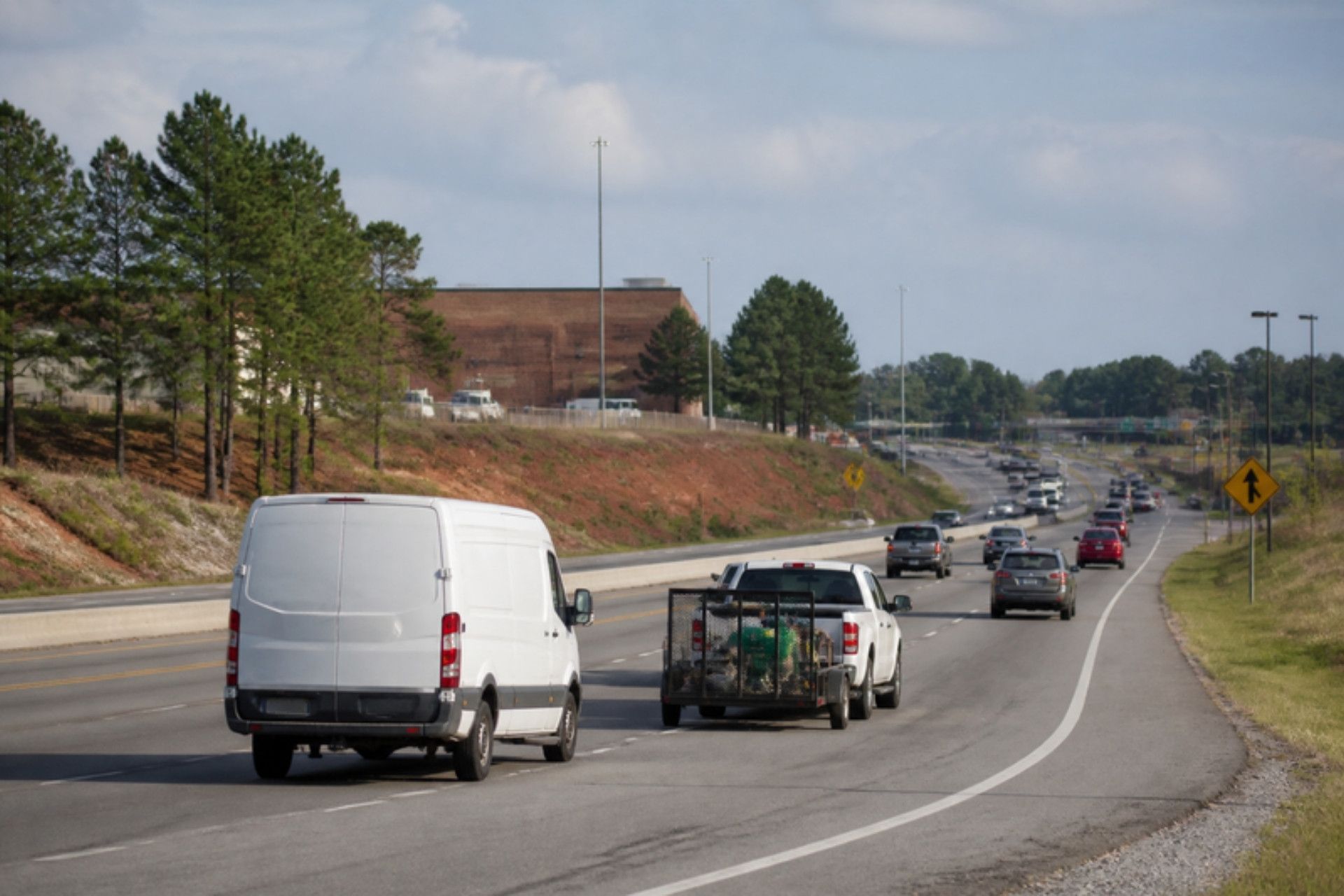
North Carolina law defines a nonfleet operation as four or fewer vehicles, which means businesses with five or more vehicles are generally rated as fleets. Single-vehicle and small nonfleet policies are rated vehicle by vehicle. Fleet policies, by contrast, often allow broader underwriting flexibility, blanket coverage features, and rating based on the operation as a whole.
Under N.C.G.S. § 58-40-10(2), a "nonfleet" motor vehicle is one of four or fewer vehicles owned or hired under a long-term contract. This distinction matters because it influences how a policy is priced and how much attention underwriters give to the operation's overall loss history. A plumbing contractor with three vans in Concord occupies a different rating category than an HVAC company operating twelve service trucks across Mecklenburg and Cabarrus counties.
Single-vehicle policies suit sole proprietors, consultants, and small trades operations whose risk is concentrated in one or two drivers. These policies are relatively simple to administer. They are, however, sensitive to the record of each listed driver, so a single at-fault accident can noticeably affect renewal pricing.
Fleet programs bring different advantages and responsibilities. Some carriers may offer automatic coverage for newly acquired vehicles, scheduled or blanket rating, and safety program credits. In return, these carriers typically expect written driver policies, regular MVR reviews, and organized vehicle maintenance records.
North Carolina Liability Limits Comparison Table
| Coverage Component | Prior Minimum (before July 1, 2025) | Current Minimum (from July 1, 2025) |
|---|---|---|
| Bodily injury, per person | $30,000 | $50,000 |
| Bodily injury, per accident | $60,000 | $100,000 |
| Property damage, per accident | $25,000 | $50,000 |
| Shorthand | 30/60/25 | 50/100/50 |
The 50/100/50 structure applies to every vehicle registered in North Carolina. Commercial operators should treat these figures as a starting point when designing their programs. Contract requirements, lender conditions, and exposure to serious injury claims usually call for considerably higher limits.
The Importance of Hired and Non-Owned Auto Coverage
Hired and non-owned auto coverage, commonly called HNOA, protects a business when employees drive rented or personal vehicles for company purposes. If an employee causes a serious accident while running a business errand in a personal car, the injured party may pursue the business directly. Without HNOA, that claim may have no coverage at all.
A frequent coverage gap arises in professional offices, real estate firms, and medical practices that own no vehicles. Their owners often assume they do not need commercial auto protection. Consider an office manager in Highland Creek who drives to the bank to make a deposit and injures a pedestrian along the way. Her personal auto policy responds first, but if the damages exceed her limits, the claimant's attorney will very likely name the employer in the lawsuit as well.
Hired auto coverage addresses vehicles the business rents, leases short-term, or borrows. Examples include a cargo van rented for a trade show at the Charlotte Convention Center, or a box truck rented to relocate an office. Non-owned auto coverage, in turn, applies to vehicles owned by employees, partners, or volunteers that are used for company business.
Several practical points shape how HNOA functions:
- HNOA is generally excess liability coverage. It does not pay for physical damage to the employee's own vehicle.
- It can often be added to a commercial auto policy, and some carriers also offer it as an endorsement to a business owners policy.
- Rental car physical damage requires separate attention, either through hired auto physical damage coverage or the rental agreement itself.
- Employers should confirm that employees who drive for business maintain personal auto limits the company considers acceptable.
HNOA is relatively inexpensive compared to the claims it addresses. It is one of the most frequently overlooked coverages in small business insurance programs, and the consequences of that gap usually surface only after a loss has already occurred.
Strict Driver Eligibility Rules and MVR Standards
Carriers evaluate every driver on a commercial policy through motor vehicle record reviews. They consider age, licensing experience, moving violations, at-fault accidents, and major convictions such as DWI. A driver who falls outside a carrier's eligibility guidelines may be excluded from the policy, may raise the premium, or may make the entire account ineligible.
The motor vehicle record, or MVR, documents a driver's license status, violations, accidents, and suspensions. Underwriting guidelines vary from carrier to carrier. Many commercial carriers are cautious about younger drivers, drivers with limited licensed experience, and drivers with recent serious violations. Reckless driving, DWI, driving while license revoked, and speeding well above the posted limit commonly lead to exclusion.
North Carolina's 2025 changes extended how long driving history continues to affect insurance rating. For drivers first licensed on or after July 1, 2025, the inexperienced operator surcharge period was extended from three years to eight years. For convictions carrying four or more Safe Driver Incentive Plan points that occur on or after that date, the lookback period grew from three years to five years. The Department of Insurance also updated accident classification thresholds to $2,300 for minor accidents and $3,850 for major accidents. These rules are written primarily for personal auto rating, but commercial underwriters review the same records, so a longer documented history shapes their decisions as well.
Businesses that manage driver risk well typically take the following steps:
- Obtain MVR authorization and run a record check before hiring anyone who will drive.
- Re-check MVRs at least annually and before each policy renewal.
- Adopt a written driver policy that defines acceptable violation history.
- Require employees to report any new citations promptly.
- Remove or restrict drivers who no longer meet the standards.
A common mistake is allowing an unlisted employee, such as a newly hired helper or a family member, to drive a company truck "just this once." If that driver turns out to be ineligible under the carrier's guidelines, the resulting claim may lead to coverage disputes or even nonrenewal.
Why North Carolina Commercial Auto Rates Keep Rising
Commercial auto premiums in North Carolina continue rising because claims cost more to settle. Social inflation, higher vehicle repair costs, and nuclear verdicts all push losses upward. Higher statutory minimums and the removal of the UIM liability setoff add further pressure, while reduced carrier competition limits the options available to many businesses.
Social inflation describes claim costs that grow faster than general economic inflation. It is driven by more aggressive litigation, attorney advertising, litigation funding, and changing jury attitudes toward corporations. Commercial vehicles bear the brunt of this trend because a company logo on the side of a truck signals deeper pockets to a jury. Plaintiff attorneys increasingly argue negligent hiring, negligent entrustment, and inadequate supervision in addition to the driver's own conduct.
Nuclear verdicts, generally understood as jury awards exceeding $10 million, have reshaped the way carriers price trucking and fleet risk nationally. A single outsized verdict can consume years of premium from an entire book of business. Even when a North Carolina case settles before trial, the possibility of an unpredictable award raises settlement values. That pressure eventually flows into rates for every policyholder.
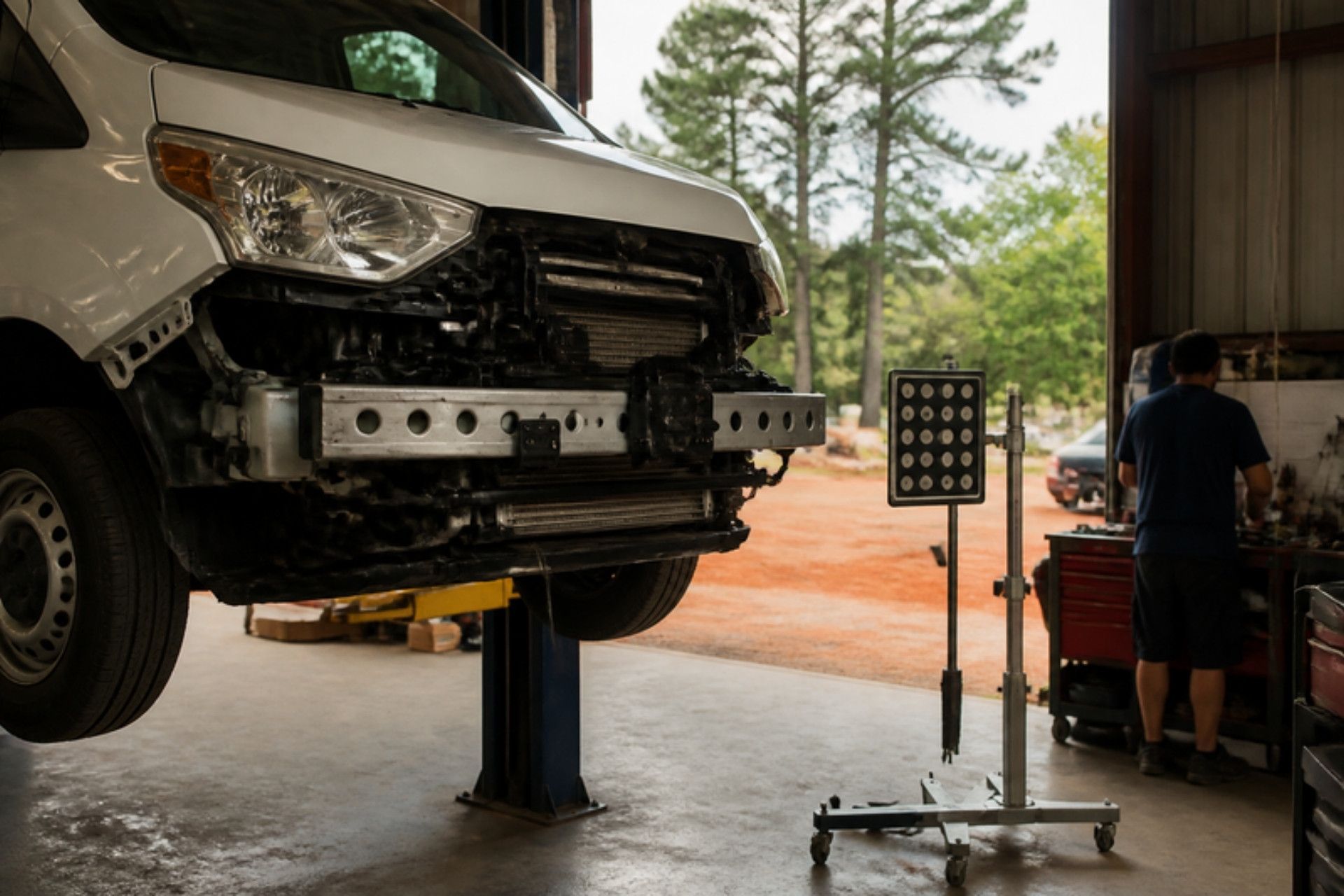
Repair costs have climbed as well. Modern vehicles contain cameras, radar sensors, and driver-assistance systems that require calibration after even minor collisions, and a bumper replacement that once involved simple bodywork may now require electronic recalibration. Labor shortages at body shops and higher parts costs lengthen repair times, which in turn increases rental and downtime expenses.
Regulatory factors also play a role. In June 2025, a settlement with the North Carolina Rate Bureaucapped the average statewide nonfleet private passenger auto rate increase at 5%, well below the 22.6% insurers had originally requested. That settlement applies to personal auto policies and is not a cap on commercial fleet renewals, which are rated separately. Some national carriers have reportedly pulled back or tightened underwriting in North Carolina, reducing competition in the market. Businesses with marginal driver records feel that contraction most acutely.
How Your Business Can Manage Rising Premiums
Premium control begins with risk control. Underwriters respond to documented evidence of safe operations, and the following measures can strengthen a renewal submission:
- Telematics and dash cameras that record driver behavior and provide evidence in disputed claims
- Written safety programs covering cell phone use, seatbelts, and backing procedures
- Consistent MVR monitoring with clear consequences for violations
- Higher deductibles on physical damage for businesses with adequate cash reserves
- Accurate vehicle schedules that remove sold or idle units promptly
- Prompt claim reporting that allows carriers to investigate before costs escalate
Marketing the account to several carriers before each renewal also helps. Pricing and appetite can differ considerably from one carrier to another.
Why Use an Independent Agent Instead of Going Direct
An independent agent represents multiple insurance carriers rather than one company. As a result, the agent can compare coverage forms, underwriting appetites, and pricing on behalf of a business. Purchasing directly from a single carrier limits the business to that carrier's products and eligibility rules, which can be restrictive for commercial accounts.
Carrier appetite varies widely for commercial auto. One carrier may welcome contractors with light trucks but decline businesses that run box trucks, while another may accept a driver with a prior violation that a third carrier would refuse outright. When a business buys direct and is declined or nonrenewed, it must start over alone. An independent agency, by contrast, can approach other markets on the business's behalf.
O'Connor Insurance Associates has operated as an independent agency in Charlotte since 2000 and has been recognized as an IIABA Best Practices Agency since 2010. The agency's approach emphasizes asking detailed questions about how vehicles are used, who drives them, and what contracts require. It then educates business owners about the differences between available options. The agency is not an insurance carrier; policies are issued and claims are paid by the carriers it represents.
Independent representation offers advantages that extend beyond the initial quote. An agent can review contract insurance requirements, identify gaps such as missing HNOA coverage, and coordinate commercial auto with general liability, workers compensation, and umbrella policies. At renewal, the account can be remarketed when conditions change, so the business is not obliged to accept whatever increase a single carrier presents.
Common Questions About North Carolina Commercial Auto Insurance
Business owners frequently raise the same questions when reviewing coverage. The answers below address the most common concerns about personal versus commercial policies, coverage for employees' vehicles, driver records, and the state's 2025 liability changes, using plain language for readers who may be new to commercial insurance.
Do I need commercial auto insurance if I use my personal truck for work?
Possibly. If the truck is titled to the business, carries tools and equipment regularly, or is used for hauling or deliveries, a personal policy may exclude the loss. An agent can review how the vehicle is actually used.
What are the minimum liability limits in North Carolina now?
Since July 1, 2025, the minimum is 50/100/50: $50,000 per person and $100,000 per accident for bodily injury, plus $50,000 for property damage.
Does my business need coverage if employees drive their own cars for errands?
Yes. Hired and non-owned auto coverage protects the business if an employee causes an accident while driving a personal or rented vehicle on company business.
Can an insurance company refuse to cover one of my drivers?
Yes. Carriers set their own eligibility guidelines, and a driver with serious violations or limited experience may be excluded or may prevent the policy from being written.
How many vehicles make my business a fleet?
Under North Carolina law, four or fewer vehicles is a nonfleet operation. Businesses with five or more vehicles are generally treated as fleets.
Why did my premium go up even though I had no claims?
Rates reflect statewide and industry claim trends, including higher repair costs and larger lawsuit awards, in addition to your own loss history.
Making the Right Choice for Your Business Fleet
The right commercial auto program matches limits to actual exposure and confirms that every driver meets carrier standards. It closes gaps such as non-owned auto liability and is reviewed before each renewal. Businesses that treat coverage as a strategic decision, rather than a compliance checkbox, are generally better positioned when a serious claim occurs.
Commercial auto coverage in North Carolina now operates under higher statutory minimums, longer driver history lookback periods, and a claims environment shaped by social inflation and costly repairs. Whether a business runs a single pickup in Harrisburg or a fleet of service vans across the Charlotte region, the fundamentals remain the same. Document safe driving, verify MVRs, and carry limits that reflect real-world injury costs. Confirm as well that employees' personal vehicles are addressed through HNOA.
O'Connor Insurance Associates, Inc. is a licensed North Carolina insurance agency (license #7014004) located at 1973 JN Pease Place, Suite 203, Charlotte, North Carolina 28262. The agency designs customized commercial insurance programs by comparing options from multiple carriers and explaining the differences clearly to each client.
Business owners seeking a review of their current coverage, or a quote for a new vehicle or fleet, may call 704-510-8884. A thoughtful conversation before the next renewal is far less costly than discovering a coverage gap after an accident.
Coverage descriptions are general. Policy terms, exclusions, limits and underwriting determine coverage.
Last updated:
On this page
O’Connor Insurance Associates is fully licensed to provide personal and commercial insurance solutions for individuals, families and businesses across North Carolina.
We proudly serve families and business owners from our office in Charlotte, North Carolina. As an independent, family-owned agency since 2000, our team works with more than one insurance company to make sure homeowners, drivers, contractors, landscapers, small businesses and other personal and commercial clients receive coverage that fits their real risks.

About the Author
President & Founder
I’m Terry O’Connor, President and Founder of O’Connor Insurance Associates. I grew up in Pennsylvania, earned my bachelor’s degree at Edinboro University and my master’s at Gannon University, and in 1998 I traded snow for sunshine and moved to Charlotte. In January 2000, I started this agency on my own because I wanted to help people protect what matters most to them. More than two decades later, we’ve grown into an independent agency serving families and businesses across North Carolina, and we’ve been recognized as an IIABA Best Practices Agency every year since 2010, a distinction held by fewer than 1% of agencies nationwide.
I’ve seen firsthand how the right protection can change a family’s or a business owner’s life, and that’s why I lead with empathy, education and honest advice. As an independent agent, I work for you, not for one insurance company. I take the time to explain your options in plain language, and when you call our office, you reach a real person who knows your account.
Outside the office, you’ll usually find me outdoors hunting or fishing, or on the mat coaching wrestling as an assistant varsity coach at Mallard Creek High School. I’m also a proud supporter of the arts, usually in the front row cheering on my daughter in local theater productions. I’d be glad to review your coverage with you. Call me at 704-510-8884 or email terry@oianc.com.
Relationships are the real measure
What our North Carolina clients say.
5.0 / 5
185 reviews on Google
Personal insurance
For the life you’re making.
Your home, your car, your time away. Let’s look at the whole picture.
Business insurance
For the business you’re building.
From established local companies to growing teams, we help make the coverage conversation clearer.
Your work deserves a closer look
Different businesses.
Different conversations.
We take time to understand what happens in your business every day.

Landscaping

Manufacturers

Technology Companies

HVAC Insurance

Electricians Insurance

Food Manufacturers
A little clarity goes a long way
Good questions.
Straight answers.
Have something else on your mind?
What does an independent insurance agency do?
An independent agency helps you compare options from more than one insurance company. We start with your needs, explain the differences and help you make an informed decision.
What can O’Connor help me insure?
Our team works with personal and business insurance, life and disability coverage, and Medicare options. Tell us what you need, and we’ll connect you with the right person.
Where does your agency serve clients?
We are based in Charlotte and serve clients across North Carolina. If your business operates in more than one state, call us to discuss your locations and coverage needs.
How do I get an insurance quote?
Start with the contact form or call 704-510-8884. We’ll ask about your situation and any current coverage, then review available options. Submitting a request does not bind coverage.
Can you help with an existing policy or claim?
Yes. Our Client Center page connects you with policy service, billing and claims options. You can also call during office hours for help finding the right next step.
What should I know before switching insurance?
Compare coverage, limits, exclusions and effective dates, not just the price. Speak with your agent before canceling an existing policy so you can coordinate the transition.
From our desk to yours
A little knowledge goes a long way.



Get a Quote
Let’s protect what you’re building.
Tell us a little about yourself. We’ll help you take the next step with a clearer picture of your options.
1973 J.N. Pease Place, Suite 203
Charlotte, NC 28262
Monday–Thursday · 9 AM–5 PM
Friday · 9 AM–3 PM
