

North Carolina landscaping insurance is a coordinated set of commercial policies, typically comprising general liability, pesticide application liability, commercial auto, workers compensation, and inland marine equipment coverage, that together protect lawn care and landscape companies from the property damage, chemical exposure, vehicle accidents, and crew injuries that define daily field operations.
Consider a three-truck crew servicing subdivisions in Highland Creek and Huntersville on a humid Tuesday in June. A zero-turn mower throws a rock through a homeowner's sliding glass door, a trailer clips a parked car on NC-73, and a seasonal laborer strains his back loading pallets of sod. All three events can occur before lunch, and each one triggers a different insurance policy with its own limits, exclusions, and reporting requirements.
For landscape and lawn care companies operating across the greater Charlotte region, insurance decisions intersect with state licensing rules administered by the North Carolina Landscape Contractors' Licensing Board and the North Carolina Department of Agriculture and Consumer Services (NCDA&CS). A policy that appears adequate on paper may still leave a contractor out of compliance with a licensing standard or exposed to a claim category that was never contemplated at purchase. The sections that follow examine each coverage line, the regulatory obligations attached to it, and the gaps that most frequently surface when claims are filed.
Understanding North Carolina Landscaping Insurance Needs
North Carolina landscaping insurance is a bundle of policies designed to protect lawn care businesses from industry-specific risks, including damage to client property, chemical drift, vehicle and trailer accidents, stolen equipment, and worker injuries. No single policy addresses all of these exposures, so coverage is assembled around the services a company actually performs.
The risk profile of a landscaping operation differs substantially from that of an office-based business. Crews work on property owned by others, operate powered equipment that propels debris at high velocity, handle regulated chemicals, and travel between multiple job sites daily with expensive machinery in tow. Each of these activities creates a distinct liability or property exposure.
Service mix is the primary factor that shapes an appropriate insurance program. A solo operator who mows residential lawns in Concord carries a far narrower risk profile than a firm installing retaining walls, irrigation systems, and hardscapes for commercial clients in Cornelius. Companies that apply fertilizers, herbicides, or insecticides introduce an additional layer of chemical liability that standard general liability forms frequently exclude or limit.
Carriers evaluate landscaping accounts based on payroll, gross receipts, vehicle schedules, equipment values, and the percentage of revenue derived from higher-hazard work such as tree trimming or chemical application. Accurate disclosure of these details at the application stage helps prevent coverage disputes later, since misclassified operations are among the most common reasons landscaping claims are delayed or contested.
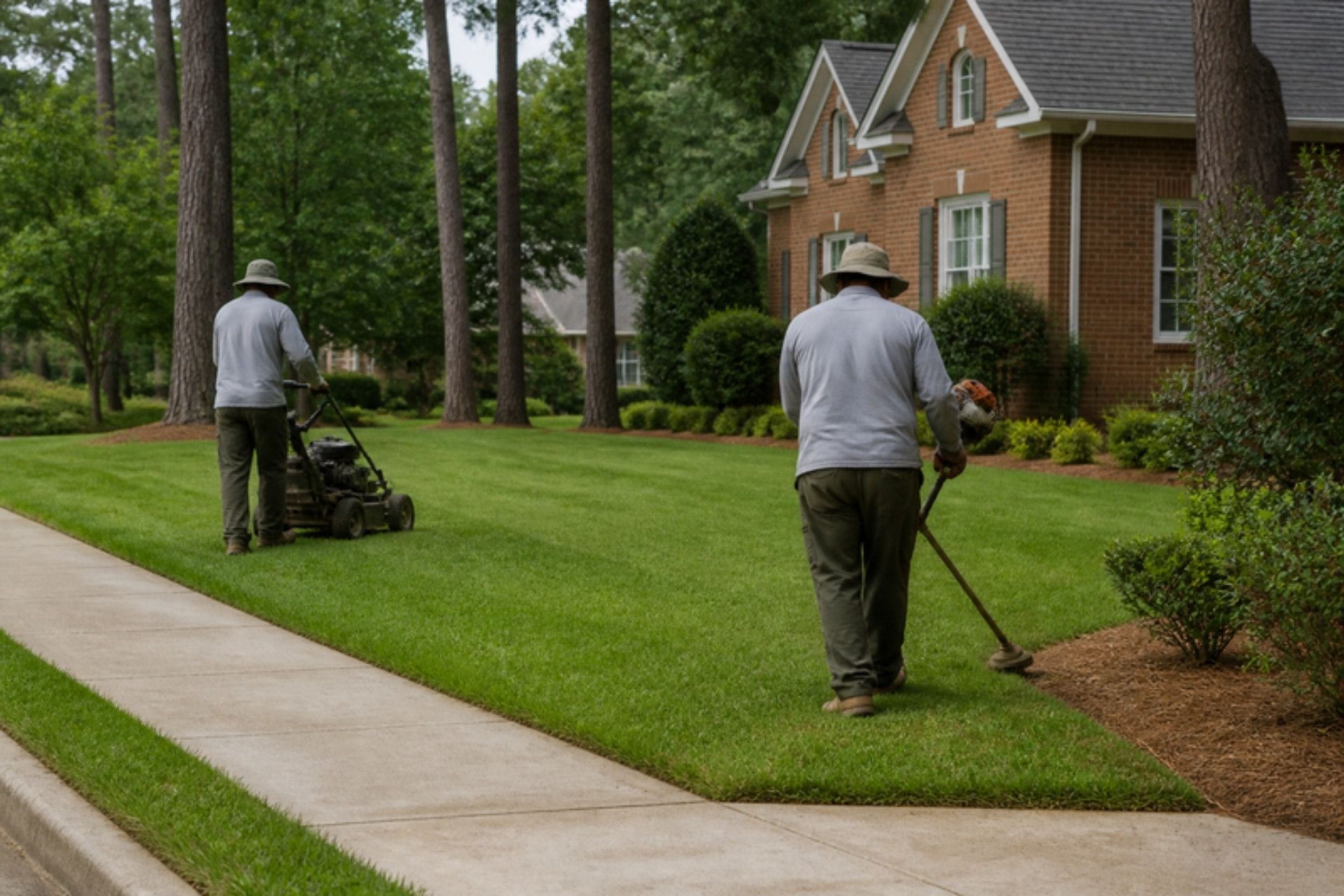
General Liability and Pesticide Application Liability
General liability protects landscaping companies against third-party bodily injury and property damage claims, while pesticide application liability addresses chemical overspray, drift, and runoff that standard policies commonly exclude. Companies holding an NCDA&CS pesticide license generally need both, since many general liability forms contain pollution exclusions that apply to applied chemicals.
General liability responds to the everyday incidents that generate the majority of landscaping claims: a string trimmer chips the paint on a client's vehicle, a visitor trips over an irrigation trench left uncovered overnight, or a crew member accidentally severs a buried cable line. As of early 2026, North Carolina landscaping businesses typically pay between $95 and $440 per month for general liability coverage, with pricing influenced by revenue, claims history, and the specific services performed.
Chemical application changes the analysis considerably. Most commercial general liability forms include a pollution exclusion broad enough to encompass herbicides, insecticides, and fungicides once they leave the sprayer. When herbicide drifts onto a neighbor's ornamental beds, or fertilizer runoff reaches a retention pond in a Harrisburg subdivision, the resulting claim may fall outside general liability entirely unless a pesticide or herbicide applicator endorsement has been added.
NCDA&CS administers pesticide licensing in North Carolina, and its rules include continuing education obligations. Commercial pesticide applicators certified before July 1, 2025, must complete a mandatory one-hour Required Pesticide Certification and Training Standards Update by June 30, 2026 to maintain their license. Allowing a license to lapse can complicate both regulatory standing and the defense of a chemical-related claim.
Financial responsibility rules also apply in certain license categories. Under 02 NCAC 34.0902, licensees must provide proof of financial responsibility with a standard minimum of $300,000 combined single limit or split limits of $100,000 property damage and $300,000 bodily injury. These standards govern structural and related pesticide applications, so landscapers who also perform perimeter pest treatments around homes should confirm which license category applies to their work and whether their policy limits satisfy it.
Meeting North Carolina Landscape Contractors Licensing Board Standards
Licensing obligations extend beyond chemical work. A North Carolina Landscape Contractor's License is required under NCGS Chapter 89D when the total value of a project, including labor and materials, reaches $30,000 or more at a single job site within a 12-month period. The North Carolina Landscape Contractors' Licensing Board oversees this credential.
Companies approaching that threshold frequently encounter commercial clients, property management firms, and general contractors who require certificates of insurance, additional insured endorsements, and waivers of subrogation before work begins. Reviewing these contractual requirements against existing policy language before signing a contract prevents the common situation in which a company wins a project and then discovers its policy cannot produce the required endorsements.
Insuring Crew Vehicles and Heavy Duty Trailers
Commercial auto insurance covers trucks, vans, and towed trailers used in landscaping operations. North Carolina raised its minimum liability limits to 50/100/50 effective July 1, 2025, and personal auto policies commonly exclude business use of heavy trucks and trailers, leaving landscapers who rely on them exposed.
The revised North Carolina minimums require $50,000 in bodily injury coverage per person, $100,000 per accident, and $50,000 in property damage liability. These figures represent the legal floor rather than a recommended level of protection. A loaded dump trailer that rear-ends a late-model SUV on I-85 during rush hour can generate medical and repair costs well beyond those minimums, and commercial clients often require $1,000,000 in auto liability before granting site access.
Personal auto policies present one of the most consequential coverage gaps in the landscaping industry. Many owners begin their businesses using a personally titled pickup and a utility trailer, and they assume their existing personal policy extends to work activities. Personal forms commonly contain business-use exclusions, weight restrictions, and limitations on trailers used for commercial purposes, which means a claim arising during a paid job may be denied outright.
Several points deserve careful attention when structuring a commercial auto program:
- Trailer scheduling: Trailers should be listed on the policy with accurate values, since liability may follow the towing vehicle while physical damage to the trailer itself requires separate scheduling.
- Hired and non-owned auto: This coverage responds when employees drive their own vehicles to pick up supplies or travel between sites.
- Driver records: Seasonal hiring brings new drivers, and carriers typically require motor vehicle record reviews before adding them.
- Cargo distinction: Equipment loaded on a trailer is generally insured under inland marine coverage rather than the auto policy.
Workers Compensation for Year Round and Seasonal Crews
North Carolina law requires workers compensation for businesses with three or more employees, and seasonal or part-time workers count toward that threshold. Landscaping companies that add spring and summer crews frequently cross the three-employee line without recognizing that their legal obligation has changed.
The seasonal nature of landscaping creates a recurring compliance problem. A company may operate through winter with an owner and one employee, then hire four additional workers in March for mulching and spring cleanups. At that moment, the business becomes subject to the mandatory coverage requirement, and operating without a policy exposes the owner to penalties and to personal liability for injury costs.
Landscaping injuries tend to fall into recognizable categories: lacerations from hedge trimmers and chainsaws, heat-related illness during July and August, back strains from lifting stone and sod, eye injuries from flying debris, and chemical exposure during application work. Each of these claims involves medical treatment and, in many cases, wage replacement benefits while the worker recovers.
Short-tenured seasonal workers raise a specific question about benefit calculation. If a worker's tenure is too short to calculate an average weekly wage, the North Carolina Industrial Commission may use the earnings of a similarly situated employee to reach a fair and just benefit amount. A laborer injured in his second week of employment may therefore receive benefits calibrated to a full-season crew member's earnings.
Workers compensation premiums are based on payroll and job classification codes. Accurate payroll estimates and correct classifications matter considerably, since year-end audits frequently reveal underreported seasonal payroll and produce substantial additional premium bills that landscaping owners did not anticipate.
Protection for Mowers and Specialized Landscaping Equipment
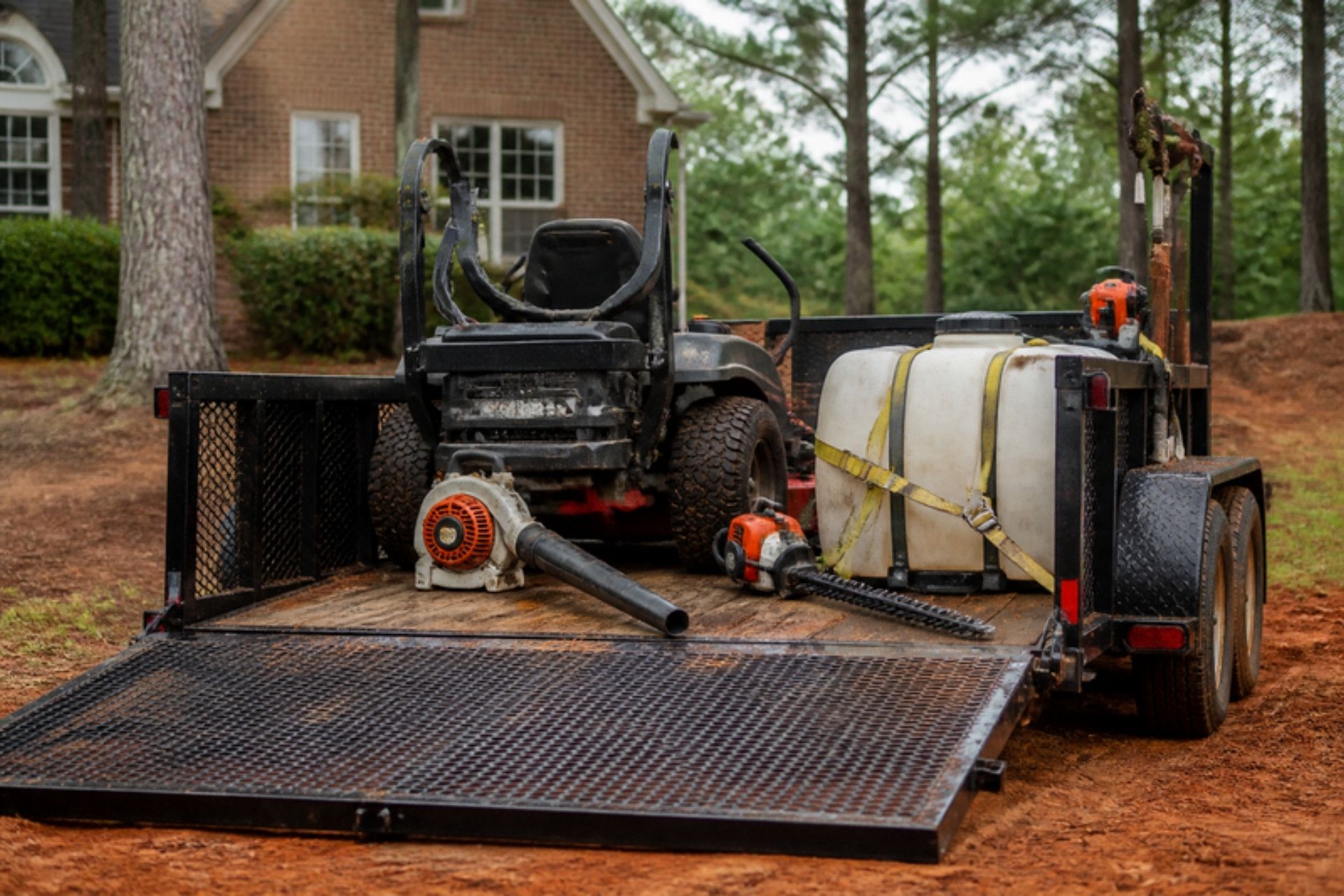
Inland marine coverage, often written as a contractor's equipment floater, insures mowers, blowers, trimmers, and hand tools that travel between job sites. Standard commercial property policies typically cover equipment only at a listed business location, so movable landscaping gear frequently requires this separate protection.
A commercial zero-turn mower represents a substantial capital investment, and a typical crew trailer may carry several mowers, backpack blowers, string trimmers, edgers, and assorted hand tools. Theft from unattended trailers parked at job sites or outside a crew leader's residence overnight is a persistent problem in the greater Charlotte area, and a single theft can sideline a crew for days.
Inland marine forms generally address theft, collision damage while in transit, fire, vandalism, and certain weather events. Coverage can be structured through scheduled items, in which each piece of equipment above a stated value is listed individually, or through blanket limits covering miscellaneous tools under a single aggregate amount. Most landscaping companies use a combination of both approaches.
Valuation terms deserve close review. Actual cash value settlements deduct depreciation, which can leave a significant shortfall when replacing a three-year-old mower, while replacement cost terms pay closer to the price of new equipment. Owners should also confirm whether the policy includes rented or leased equipment, since companies frequently rent aerators, sod cutters, and skid steers during peak season and assume responsibility for that equipment under the rental agreement.
Comparing Essential vs Comprehensive Coverage Options
Essential coverage typically includes general liability, minimum commercial auto, and required workers compensation. Comprehensive programs add equipment breakdown, pesticide and herbicide endorsements, higher auto limits, inland marine, and umbrella protection, closing gaps that frequently appear when claims involve chemicals, machinery failure, or large losses.
The appropriate level depends on services offered, contract requirements, and the owner's tolerance for uninsured loss. The comparison below outlines general distinctions; specific terms vary by carrier and policy form.
| Coverage Area | Essential Program | Comprehensive Program |
|---|---|---|
| General liability | Standard limits, basic form | Higher limits with contractor-specific endorsements |
| Pesticide/herbicide drift | Often excluded | Applicator endorsement added |
| Commercial auto | Near 50/100/50 state minimum | Higher limits, often $1,000,000 |
| Trailers | Liability only | Physical damage scheduled |
| Equipment theft | Not included | Inland marine floater |
| Equipment breakdown | Not included | Mechanical failure coverage |
| Workers compensation | Statutory requirement met | Includes accurate seasonal payroll |
| Umbrella | Not included | Excess limits over primary policies |
Equipment breakdown coverage addresses mechanical and electrical failures that standard property and inland marine forms commonly exclude. A blown hydraulic system on a mower in the middle of peak season can carry significant repair costs, and the associated downtime affects revenue as well.
Umbrella coverage offers another meaningful distinction. A serious auto accident involving a crew truck can produce a judgment exceeding primary limits, and the umbrella responds above the auto, general liability, and employer's liability policies. For companies bidding on commercial contracts, umbrella limits are often a contractual requirement.
Common Questions About North Carolina Landscaping Insurance
These answers address the questions landscaping owners raise most frequently. Individual circumstances vary, so specific policy terms should always be confirmed with a licensed agent who can review the actual coverage forms and contracts involved.
Do I need insurance for my lawn mower trailer?
Yes, a trailer used for business should be listed on a commercial auto policy. Personal auto policies commonly exclude business-use trailers, and physical damage to the trailer itself usually requires separate scheduling.
Does my pesticide license require specific insurance?
Certain NCDA&CS license categories require proof of financial responsibility, such as a $300,000 combined single limit for structural and related applications. Applicators should confirm the requirements for their specific license category and verify that their liability policy does not exclude chemical work.
Do I need workers comp if I only hire help in the summer?
If seasonal hires bring the total to three or more employees, North Carolina law requires workers compensation. Part-time and seasonal workers count toward that number.
Will my general liability policy cover herbicide drift onto a neighbor's yard?
Often it will not, because many general liability forms contain pollution exclusions. A pesticide or herbicide applicator endorsement is typically needed for this exposure.
When do I need a North Carolina Landscape Contractor's License?
A license is required when a single project at one job site totals $30,000 or more in labor and materials within a 12-month period.
Are my mowers covered by my business property policy?
Usually only while they remain at the listed business location. Equipment that travels to job sites generally needs inland marine coverage.
Working With an Independent North Carolina Insurance Agency
Landscaping owners often search for a specific carrier by name, but an independent agency can compare multiple carriers on a single application. That comparison matters because carriers differ in appetite for chemical application, trailer schedules, and seasonal payroll, and no single carrier fits every landscaping operation.
Business owners frequently look for particular carriers because of name recognition, a referral from another contractor, or a commercial client's request. Those reasons are understandable, yet going direct to one carrier limits the comparison to that company's underwriting guidelines and pricing. A carrier that writes a mowing-only account favorably may decline or surcharge a company with substantial herbicide revenue, while another carrier may welcome that same account.
O'Connor Insurance Associates, an independent agency serving the Charlotte area since 2000 and recognized as an IIABA Best Practices Agency since 2010, represents multiple carriers rather than a single company. The agency does not issue policies itself; coverage is provided by the carriers it represents, and features, endorsements, and pricing vary by carrier and by the details of each operation.
The agency's approach centers on asking questions and educating clients before recommending coverage. For a landscaping company, that process typically includes:
- Service review: Identifying mowing, installation, hardscape, irrigation, and chemical application revenue.
- License alignment: Matching policy limits to NCDA&CS and North Carolina Landscape Contractors' Licensing Board requirements.
- Contract review: Confirming that additional insured and waiver requirements can be met.
- Quote comparison: Presenting options from multiple carriers for side-by-side evaluation.
To request a quote, owners can contact the office at 704-510-8884 or visit 1973 JN Pease Place, Suite 203, Charlotte, North Carolina 28262, with vehicle schedules, equipment lists, payroll estimates, and current license information available. O'Connor Insurance Associates is a licensed North Carolina insurance agency (license #7014004).
Making the Right Choice for Your Lawn Care Business
The right landscaping insurance program for a North Carolina company is one in which licensing obligations, contract requirements, and policy limits align without gaps. A professional review of actual operations, rather than a generic package, is the most reliable way to achieve that alignment.
The most expensive coverage problems in this industry rarely stem from a lack of insurance altogether. They arise from mismatches: a pesticide license requiring financial responsibility that a pollution exclusion quietly undermines, a seasonal crew that pushes headcount past three employees without a workers compensation policy in place, a personal auto policy covering a truck that tows a business trailer, or a mower stolen from a job site that only a property policy, limited to the shop address, was expected to cover.
Each spring, before seasonal hiring begins and before new commercial contracts are signed, landscaping owners benefit from a structured review of their vehicle schedule, equipment values, payroll projections, and license status. The June 30, 2026 recertification deadline for pesticide applicators certified before July 1, 2025, provides a natural checkpoint for that review.
Business owners in Charlotte, Huntersville, Cornelius, Concord, Harrisburg, and Highland Creek can schedule a coverage review with O'Connor Insurance Associates by calling 704-510-8884. A careful conversation now, comparing the specific risks of the business against licensing requirements and policy language, helps ensure that the disaster no one planned for remains a covered event rather than an uninsured loss.
Coverage descriptions are general. Policy terms, exclusions, limits and underwriting determine coverage.
Last updated:
On this page
O’Connor Insurance Associates is fully licensed to provide personal and commercial insurance solutions for individuals, families and businesses across North Carolina.
We proudly serve families and business owners from our office in Charlotte, North Carolina. As an independent, family-owned agency since 2000, our team works with more than one insurance company to make sure homeowners, drivers, contractors, landscapers, small businesses and other personal and commercial clients receive coverage that fits their real risks.

About the Author
President & Founder
I’m Terry O’Connor, President and Founder of O’Connor Insurance Associates. I grew up in Pennsylvania, earned my bachelor’s degree at Edinboro University and my master’s at Gannon University, and in 1998 I traded snow for sunshine and moved to Charlotte. In January 2000, I started this agency on my own because I wanted to help people protect what matters most to them. More than two decades later, we’ve grown into an independent agency serving families and businesses across North Carolina, and we’ve been recognized as an IIABA Best Practices Agency every year since 2010, a distinction held by fewer than 1% of agencies nationwide.
I’ve seen firsthand how the right protection can change a family’s or a business owner’s life, and that’s why I lead with empathy, education and honest advice. As an independent agent, I work for you, not for one insurance company. I take the time to explain your options in plain language, and when you call our office, you reach a real person who knows your account.
Outside the office, you’ll usually find me outdoors hunting or fishing, or on the mat coaching wrestling as an assistant varsity coach at Mallard Creek High School. I’m also a proud supporter of the arts, usually in the front row cheering on my daughter in local theater productions. I’d be glad to review your coverage with you. Call me at 704-510-8884 or email terry@oianc.com.
Relationships are the real measure
What our North Carolina clients say.
5.0 / 5
185 reviews on Google
Personal insurance
For the life you’re making.
Your home, your car, your time away. Let’s look at the whole picture.
Business insurance
For the business you’re building.
From established local companies to growing teams, we help make the coverage conversation clearer.
Your work deserves a closer look
Different businesses.
Different conversations.
We take time to understand what happens in your business every day.

Landscaping

Manufacturers

Technology Companies

HVAC Insurance

Electricians Insurance

Food Manufacturers
A little clarity goes a long way
Good questions.
Straight answers.
Have something else on your mind?
What does an independent insurance agency do?
An independent agency helps you compare options from more than one insurance company. We start with your needs, explain the differences and help you make an informed decision.
What can O’Connor help me insure?
Our team works with personal and business insurance, life and disability coverage, and Medicare options. Tell us what you need, and we’ll connect you with the right person.
Where does your agency serve clients?
We are based in Charlotte and serve clients across North Carolina. If your business operates in more than one state, call us to discuss your locations and coverage needs.
How do I get an insurance quote?
Start with the contact form or call 704-510-8884. We’ll ask about your situation and any current coverage, then review available options. Submitting a request does not bind coverage.
Can you help with an existing policy or claim?
Yes. Our Client Center page connects you with policy service, billing and claims options. You can also call during office hours for help finding the right next step.
What should I know before switching insurance?
Compare coverage, limits, exclusions and effective dates, not just the price. Speak with your agent before canceling an existing policy so you can coordinate the transition.
From our desk to yours
A little knowledge goes a long way.



Get a Quote
Let’s protect what you’re building.
Tell us a little about yourself. We’ll help you take the next step with a clearer picture of your options.
1973 J.N. Pease Place, Suite 203
Charlotte, NC 28262
Monday–Thursday · 9 AM–5 PM
Friday · 9 AM–3 PM
