

Uptown Charlotte condo insurance, commonly written as an HO6 policy, protects the interior of a high-rise unit, your personal belongings, and your personal liability. The homeowners association master policy, by contrast, insures the building shell and common elements. Knowing exactly where one policy ends and the other begins is the foundation of sound coverage for any Center City condominium owner.
Owners in the towers surrounding Romare Bearden Park, along South Tryon Street, and throughout the Fourth Ward face a distinct set of risks. Stacked units, shared plumbing risers, and building-wide deductibles create exposures that a detached home in Huntersville or Concord would rarely encounter. A single failed supply line twenty floors up can affect a dozen residences below it within an hour. For that reason, the review of a high-rise condominium policy deserves more attention than a routine renewal notice typically receives. The sections that follow cover walls-in protection, the master policy, loss assessment, and water intrusion from neighboring units.
Understanding Uptown Charlotte North Carolina Condo Insurance
Uptown Charlotte condo insurance, known as HO6 coverage, protects the interior of a high-rise unit, including finishes, fixtures, personal property, and liability, while the HOA master policy covers the building shell, roof, and common elements. The two policies are designed to work together, and gaps arise when owners assume one policy covers what the other does.
The division of responsibility in North Carolina is set largely by statute. The North Carolina Condominium Act governs all units created after October 1, 1986, and it requires associations to maintain property insurance on common elements and, in stacked-unit buildings, on the units themselves to the extent reasonably available. Under the same chapter, the association is responsible for maintaining common elements, while each owner is responsible for maintaining his or her own unit.
North Carolina associations for buildings established after that 1986 date are also legally required to carry property insurance for at least 80% of replacement cost. That requirement offers a measure of protection, but it does not guarantee that every interior upgrade, appliance, or custom finish within an individual unit will be restored at the association's expense.
The practical result is a layered arrangement. The master policy addresses the structure, the HO6 policy addresses the owner's interest inside that structure, and the governing documents of the association define the precise boundary between the two. Owners who read those documents carefully before purchasing coverage tend to avoid the most common and costly surprises at claim time.

The Essentials of HO6 Walls-In Coverage for High-Rise Units
An HO6 policy generally covers everything from the studs or paint inward, including flooring, cabinetry, countertops, built-in appliances, and plumbing and electrical fixtures within the unit. It also protects personal belongings, provides liability coverage, and pays additional living expenses when a covered loss makes the residence uninhabitable during repairs.
The term "walls-in" describes the core function of the policy. In a typical Uptown tower, the master policy insures the concrete, structural framing, exterior glass, and shared mechanical systems, while the HO6 policy responds to damage to interior surfaces. Hardwood or luxury vinyl flooring, tile backsplashes, quartz countertops, custom closet systems, and light fixtures commonly fall within the owner's portion of responsibility.
A properly structured HO6 policy usually comprises several distinct coverage parts:
- Dwelling (Coverage A): Interior finishes, improvements, and betterments within the unit
- Personal Property (Coverage C): Furniture, electronics, clothing, and other belongings
- Loss of Use (Coverage D): Hotel stays, short-term rentals, and related expenses during repairs
- Personal Liability (Coverage E): Injury or property damage the owner causes to others
- Loss Assessment: The owner's share of a covered building-wide claim
Several carriers that serve the Charlotte market offer coverage enhancements that may suit high-rise living. Erie, Travelers, and Cincinnati may provide endorsements for items such as water backup, increased loss assessment limits, and replacement cost on personal property, although availability and terms vary by policy form and underwriting. Endorsement language differs meaningfully from one carrier to another, so a side-by-side review of the actual policy forms is generally more useful than a comparison of premium alone.
One frequent mistake involves an owner who renovates a unit and never updates the dwelling limit. A $60,000 kitchen and bathroom remodel completed after purchase may not be reflected in a policy written for the original builder-grade finishes.
Reading Your HOA Master Policy to Avoid Coverage Gaps
The type of master policy your association carries determines how much dwelling coverage your HO6 policy needs. A bare walls policy leaves nearly all interior finishes to the owner, while an all-in policy covers original finishes and upgrades. Requesting the master policy declarations and the governing documents is the essential first step.
High-rise master policies in Charlotte generally fall into one of three categories:
- Bare Walls: The association insures the structure only, leaving flooring, cabinetry, fixtures, and wall coverings to the individual owner.
- Single Entity: The association insures the structure and the original finishes installed by the developer, but not later improvements made by owners.
- All-In: The association insures the structure, original finishes, and owner upgrades, subject to the master policy deductible.
North Carolina law requires master policies for buildings with horizontal unit boundaries to include the units themselves to the extent reasonably available, though owner improvements may be excluded. That exclusion is precisely where many coverage gaps originate. An owner in a single entity building who has replaced carpet with wide-plank oak flooring may discover that the upgrade belongs entirely to the HO6 policy.
The master policy deductible matters just as much as the policy type. Some Uptown associations carry deductibles of $25,000 or more per occurrence, and governing documents often allow the association to pass that deductible to the owner whose unit was the source of the loss. Progressive and National General may offer HO6 options with varying deductible structures and loss assessment limits, which can help owners align personal coverage with the specific terms of their building.
There is some encouraging news on the market side. Industry observers have noted that the condo insurance market is turning a corner, with renewal increases for well-maintained buildings slowing to roughly 2% to 5%. Associations can also pursue savings directly, since the North Carolina Department of Insurance
allows mitigation credits for buildings that invest in fortified systems and roofs to help lower master policy premiums.
Loss Assessment Limits and Building Deductibles
Loss assessment coverage pays a unit owner's share of a covered claim that the association levies against all owners, typically when a building-wide loss exceeds master policy limits or falls within its deductible. For Uptown high-rise owners, the limit selected on this coverage part can determine whether a special assessment is affordable or financially disruptive.
Consider a scenario in which a fire in a shared mechanical room causes $500,000 in damage and the association carries a $50,000 master deductible. If the board divides that deductible among 200 owners, each owner may receive an assessment of $250. Should a liability judgment arising from an injury in the lobby exceed the association's liability limits, however, the per-unit assessment could reach many thousands of dollars.
Standard HO6 forms often include a modest loss assessment limit, and many carriers permit owners to increase that limit by endorsement for a relatively small additional premium. The coverage generally responds only when the underlying cause of loss would have been covered under the owner's own policy, so the language of the endorsement deserves careful reading.
Wind and hail deductibles deserve brief mention because owners frequently ask about them. These percentage-based deductibles are mainly a coastal issue in North Carolina and are rarely used in the Charlotte area. Most Uptown master policies and HO6 policies apply a standard all-peril deductible instead, which simplifies the calculation of potential assessments for local owners.
Comparison of Standard vs. Enhanced Loss Assessment
| Feature | Standard Limit | Enhanced Limit |
|---|---|---|
| Typical coverage amount | Low base limit | Increased by endorsement |
| Master deductible share | Partial protection | Broader protection |
| Liability assessments | Often insufficient | Better suited to large judgments |
| Additional premium | Included | Modest added cost |
| Fit for Uptown towers | Limited | Generally more appropriate |
Owners in buildings with large master deductibles or thin association reserves generally benefit from reviewing the enhanced option with an agent.
Handling Water Damage from Units Above
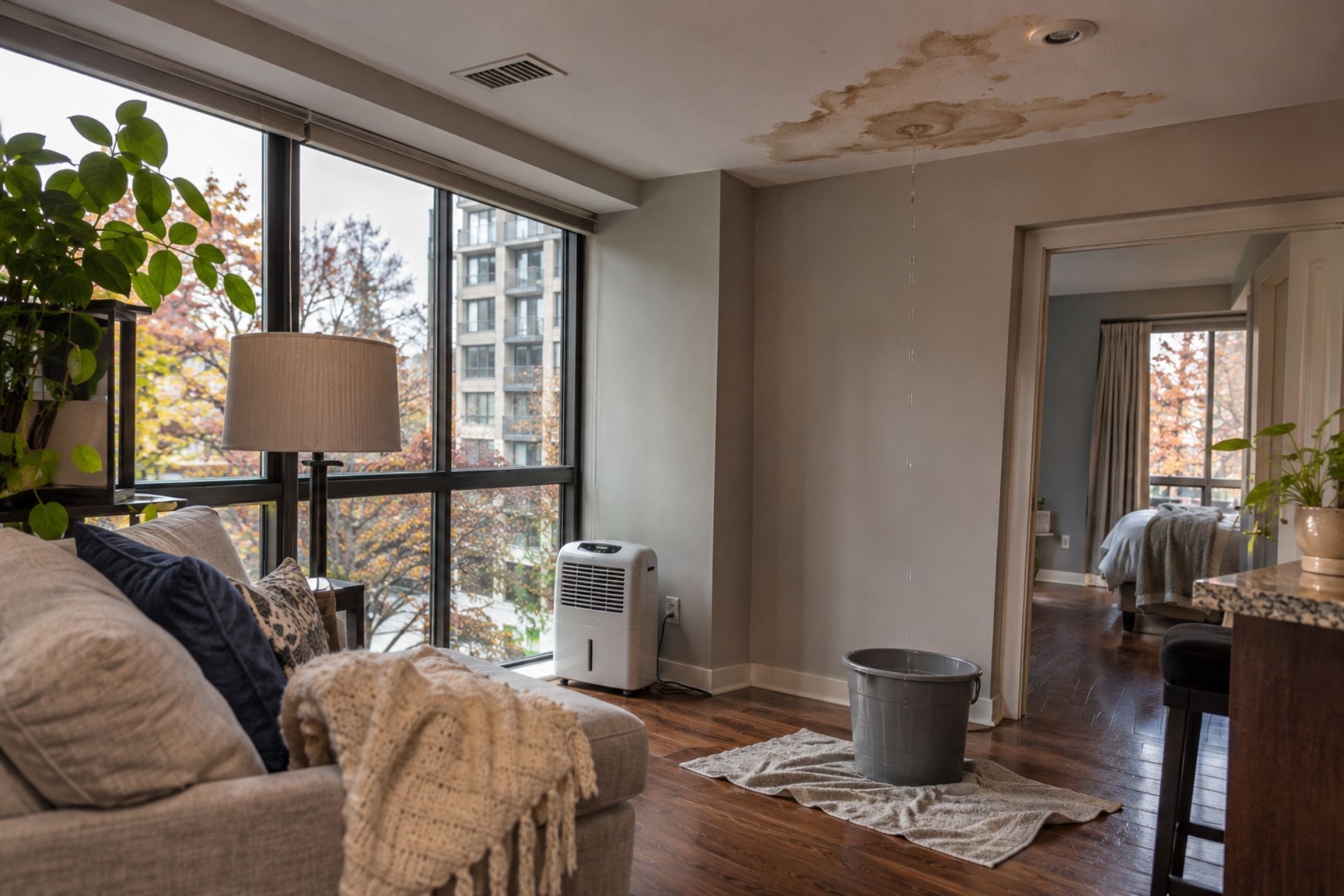
Water damage from units above is one of the most frequent claims in Uptown high-rises. In most cases, each owner's HO6 policy pays to repair his or her own unit regardless of where the leak began, and the insurers may later pursue recovery from the responsible party if negligence can be established.
Owners are often surprised to learn that the upstairs neighbor's insurance does not automatically pay for their damage. A burst washing machine hose, a cracked toilet supply line, or an overflowing bathtub on the floor above is typically treated as an accidental discharge. Unless the upstairs owner was demonstrably negligent, such as ignoring a known leak for weeks, the liability coverage on that neighbor's policy may not respond at all.
Utica and Foremost, among other carriers, may handle these situations through two separate coverage parts. The property portion of the affected owner's policy pays for damaged flooring, drywall, cabinetry, and belongings, subject to the deductible. The liability portion of the upstairs owner's policy may respond if a claim is made and fault is established, and the carriers may resolve recovery between themselves through subrogation.
Several practical steps reduce both the frequency and severity of these losses:
- Install automatic water shutoff valves or leak sensors under sinks, behind toilets, and near water heaters.
- Replace rubber washing machine hoses with braided stainless steel lines.
- Document the condition and value of interior finishes with photographs before any loss occurs.
- Confirm whether your association bylaws assign the master deductible to the unit where a leak originated.
That last point is critical. If your unit is the source of a leak that damages several floors, your loss assessment and liability limits may be tested at the same time, which reinforces the value of adequate limits on both coverage parts.
Comparing Condo Insurance Coverage Options
Comparing HO6 coverage options means evaluating each coverage part separately rather than looking only at the total premium. Personal property, dwelling additions and alterations, loss of use, and loss assessment limits vary considerably between policy levels, and the differences become apparent only when a claim is filed.
The table below illustrates how a basic policy structure differs from an enhanced structure that is often more appropriate for an Uptown high-rise unit. Actual limits and options depend on the carrier, the building, and the owner's circumstances.
| Coverage Part | Basic Structure | Enhanced Structure | Value Difference |
|---|---|---|---|
| Personal Property | Actual cash value | Replacement cost | Pays to replace items without depreciation |
| Dwelling (Additions/Alterations) | Original finishes only | Includes owner upgrades | Protects renovations and custom work |
| Loss of Use | Limited dollar amount | Higher limit or longer duration | Covers extended displacement in Uptown rental market |
| Loss Assessment | Low base limit | Increased by endorsement | Absorbs larger master deductible shares |
| Water Backup | Often excluded | Available by endorsement | Covers drain and sewer backup |
Loss of use deserves particular attention in Center City. Short-term furnished housing in Uptown can be expensive, and repairs in a high-rise frequently take longer than in a single-family home because contractors must coordinate elevator access, building management approval, and work hours with the association.
The dwelling line is where owners in single entity and bare walls buildings most often underinsure. A useful exercise involves totaling the cost of every improvement made since purchase, including flooring, lighting, built-ins, and appliances, and comparing that figure against the current Coverage A limit. Many owners find a meaningful shortfall.
Common Questions About Center City Condo Coverage
Center City condominium owners tend to ask similar questions about where the master policy ends and personal coverage begins. The answers below address the issues that arise most frequently in Uptown high-rise buildings and offer a starting point for a more detailed conversation with a licensed agent.
Does my HOA cover my floors?
That depends on the master policy type. A bare walls policy leaves flooring to the owner, a single entity policy may cover original flooring only, and an all-in policy may cover upgrades as well.
What happens if a pipe bursts upstairs and floods my unit?
Your own HO6 policy typically pays to repair your unit, less your deductible. Your insurer may later seek reimbursement from the upstairs owner if negligence can be shown.
Is HO6 coverage required for an Uptown condo?
North Carolina law does not mandate it, but most mortgage lenders and many association bylaws require it. Even without a requirement, it is the only way to protect your belongings, improvements, and liability.
How much loss assessment coverage should I carry?
The appropriate limit depends on your association's master deductible, reserves, and liability limits. Reviewing the master policy declarations helps determine a sensible figure.
Do I need wind and hail coverage in Charlotte?
Wind and hail are generally covered perils under standard forms. Separate wind and hail deductibles are mainly a coastal issue and are rarely used in the Charlotte area.
Does my policy cover my belongings in a storage unit in the building?
Personal property coverage often extends to belongings in an assigned storage area. Limits and conditions vary, so confirming the terms with your agent is advisable.
Making the Right Choice for Your Uptown Residence
The right Uptown condo policy begins with the master policy declarations, the association bylaws, and an honest inventory of improvements. With those documents in hand, owners can match dwelling, loss assessment, and loss of use limits to the actual exposures of a stacked, shared-system high-rise building.
High-rise ownership in Center City offers convenience and an exceptional location, yet it also brings shared risks that a single policy cannot address alone. The master policy, the HO6 policy, and the governing documents together determine who pays when a pipe fails, when a deductible is assessed, or when a renovation is damaged. Gaps tend to appear where owners assume rather than verify.
As an independent agency, O'Connor Insurance Associates compares options from carriers including Erie, Travelers, Cincinnati, Progressive, National General, Utica, and Foremost, and the agency's educational approach centers on asking questions and reviewing master policy terms before recommending coverage. The agency does not underwrite policies itself; coverage is issued by the carriers it represents, subject to their terms and eligibility guidelines.
O'Connor Insurance Associates is a licensed North Carolina insurance agency (license #7014004) located at 1973 JN Pease Place, Suite 203, Charlotte, NC 28262, and has been helping residents across the greater Charlotte area since 2000. Owners who would like a review of their current HO6 policy alongside their association's master policy may call 704-510-8884 to schedule a conversation. A thorough review today is far more convenient than discovering a coverage gap after water has already reached the floor below.
Last updated:
On this page
O’Connor Insurance Associates is fully licensed to provide personal and commercial insurance solutions for individuals, families and businesses across North Carolina.
We proudly serve families and business owners from our office in Charlotte, North Carolina. As an independent, family-owned agency since 2000, our team works with more than one insurance company to make sure homeowners, drivers, contractors, landscapers, small businesses and other personal and commercial clients receive coverage that fits their real risks.

About the Author
President & Founder
I’m Terry O’Connor, President and Founder of O’Connor Insurance Associates. I grew up in Pennsylvania, earned my bachelor’s degree at Edinboro University and my master’s at Gannon University, and in 1998 I traded snow for sunshine and moved to Charlotte. In January 2000, I started this agency on my own because I wanted to help people protect what matters most to them. More than two decades later, we’ve grown into an independent agency serving families and businesses across North Carolina, and we’ve been recognized as an IIABA Best Practices Agency every year since 2010, a distinction held by fewer than 1% of agencies nationwide.
I’ve seen firsthand how the right protection can change a family’s or a business owner’s life, and that’s why I lead with empathy, education and honest advice. As an independent agent, I work for you, not for one insurance company. I take the time to explain your options in plain language, and when you call our office, you reach a real person who knows your account.
Outside the office, you’ll usually find me outdoors hunting or fishing, or on the mat coaching wrestling as an assistant varsity coach at Mallard Creek High School. I’m also a proud supporter of the arts, usually in the front row cheering on my daughter in local theater productions. I’d be glad to review your coverage with you. Call me at 704-510-8884 or email terry@oianc.com.
Relationships are the real measure
What our North Carolina clients say.
5.0 / 5
185 reviews on Google
Personal insurance
For the life you’re making.
Your home, your car, your time away. Let’s look at the whole picture.
Business insurance
For the business you’re building.
From established local companies to growing teams, we help make the coverage conversation clearer.
Your work deserves a closer look
Different businesses.
Different conversations.
We take time to understand what happens in your business every day.

Landscaping

Manufacturers

Technology Companies

HVAC Insurance

Electricians Insurance

Food Manufacturers
A little clarity goes a long way
Good questions.
Straight answers.
Have something else on your mind?
What does an independent insurance agency do?
An independent agency helps you compare options from more than one insurance company. We start with your needs, explain the differences and help you make an informed decision.
What can O’Connor help me insure?
Our team works with personal and business insurance, life and disability coverage, and Medicare options. Tell us what you need, and we’ll connect you with the right person.
Where does your agency serve clients?
We are based in Charlotte and serve clients across North Carolina. If your business operates in more than one state, call us to discuss your locations and coverage needs.
How do I get an insurance quote?
Start with the contact form or call 704-510-8884. We’ll ask about your situation and any current coverage, then review available options. Submitting a request does not bind coverage.
Can you help with an existing policy or claim?
Yes. Our Client Center page connects you with policy service, billing and claims options. You can also call during office hours for help finding the right next step.
What should I know before switching insurance?
Compare coverage, limits, exclusions and effective dates, not just the price. Speak with your agent before canceling an existing policy so you can coordinate the transition.
From our desk to yours
A little knowledge goes a long way.



Get a Quote
Let’s protect what you’re building.
Tell us a little about yourself. We’ll help you take the next step with a clearer picture of your options.
1973 J.N. Pease Place, Suite 203
Charlotte, NC 28262
Monday–Thursday · 9 AM–5 PM
Friday · 9 AM–3 PM
