

Owners of motorhomes and travel trailers in North Carolina need protection for the road, the campsite, and every stop in between. A sound North Carolina RV insurance program combines state-required liability with physical damage coverage, personal belongings protection, and campsite liability, and it adjusts for whether the unit is motorized, towed, or lived in full time.
A family from Huntersville may spend a spring weekend near Boone, return home to Charlotte, and then tow the same trailer to Cape Hatteras by July. Each of those trips carries a different risk profile, including mountain grades, coastal storms, crowded campgrounds, and guests gathering around a fire ring. The coverage decisions made before departure determine whether a fallen tree limb, a slip on wet steps, or a stolen generator becomes a minor inconvenience or a significant out-of-pocket expense.
Understanding North Carolina RV Insurance Basics
North Carolina RV insurance is more than an auto policy with a larger vehicle attached. A properly designed policy protects the RV as a vehicle on public roads and also covers the lifestyle elements of travel, including personal belongings, campsite liability, emergency lodging, and attached equipment such as awnings and satellite dishes.
A standard personal auto policy is written around commuting and everyday driving, and it was never designed to account for a vehicle that also serves as a kitchen, bedroom, and living room. When an RV is parked at a campground with the slide-outs extended and the awning deployed, the exposure resembles a small home more than a car. Specialized RV forms recognize this dual nature and include provisions that auto contracts typically omit.
The core building blocks of most RV programs include the following:
- Liability: Bodily injury and property damage owed to others when the RV is at fault on the road.
- Collision and comprehensive: Physical damage from accidents, hail, falling trees, fire, theft, and flooding.
- Personal effects: Clothing, electronics, cookware, and outdoor gear stored inside the unit.
- Emergency expense: Lodging and transportation when a covered loss leaves the RV uninhabitable far from home.
- Roadside assistance: Towing services sized for heavy vehicles, which standard auto roadside plans may not accommodate.
Pricing has steadied after a turbulent period. Market trends for 2026 show stabilization in the RV insurance market following sharp rate increases in 2024 and 2025, with national average premiums near $1,500 annually for motorhomes and $600 for travel trailers. Individual North Carolina premiums vary widely based on unit value, usage, driving history, and storage location.
Liability Differences Between Motorhomes and Travel Trailers
Motorized RVs, including Class A, B, and C motorhomes, require their own liability policy because they are self-propelled vehicles registered for road use. Towable travel trailers and fifth wheels typically receive liability protection from the tow vehicle's auto policy while in motion, although physical damage to the trailer itself generally requires separate coverage.
The distinction matters most after an accident. If a Class C motorhome rear-ends another vehicle on I-40 near Statesville, the motorhome's own liability limits respond to the injuries and damage. If a travel trailer sways into an adjacent lane on I-77, the tow vehicle's liability coverage usually responds, because the trailer is treated as an extension of the truck or SUV pulling it.
A common coverage gap appears once the trailer is unhitched. The tow vehicle's liability generally does not follow a detached trailer sitting at a campsite, which leaves the owner without protection if a visitor trips over a stabilizer jack or a leveling block. Owners of towables frequently assume their auto policy handles everything, and that assumption tends to surface only after a claim is filed.
Another frequent oversight involves the tow vehicle's limits themselves. A 30-foot trailer can cause far more damage in a jackknife incident than the pickup alone, so owners should confirm that the tow vehicle carries liability limits proportionate to the combined exposure rather than the state minimum.
North Carolina Minimum Liability Limits
Mandatory liability limits for motorized RVs increased on July 1, 2025, to $50,000 for bodily injury per person, $100,000 for bodily injury per accident, and $50,000 for property damage, commonly written as 50/100/50. Uninsured and underinsured motorist coverage is also now mandatory for all new or renewed North Carolina policies as of that same date, matching the 50/100/50 limits.
A further administrative change takes effect later this year. Beginning October 1, 2026, vehicle owners will have an extended 30-day window to respond to liability insurance termination notices, up from 10 days, before facing penalties. Owners who allow a seasonal motorhome policy to lapse during winter storage should pay close attention to this rule, since cancelling liability on a registered vehicle can still trigger a notice.
State minimums represent a legal floor rather than a recommendation. A single serious injury claim involving a heavy motorhome can exceed $50,000 quickly, so many owners select considerably higher limits and pair them with a personal umbrella policy.
What is Full-Timer Liability Coverage?
Full-timer coverage is an endorsement for owners who use their RV as a primary residence for more than six months of the year. It replaces the protection a homeowners policy would normally provide, extending personal liability and medical payments coverage beyond the vehicle to everyday activities, whether the RV is parked in North Carolina or traveling.
Retirees from Cornelius who sell their house and travel year-round, or remote workers who base themselves at a long-term campground near Lake Norman, no longer carry a homeowners or renters policy. Without that policy, there is no personal liability protection for incidents that have nothing to do with driving. A dog bite at a campground, a guest injured while helping set up an awning, or accidental damage to a neighbor's site would otherwise fall outside an ordinary RV form.
Full-timer endorsements generally address several areas:
- Personal liability: Protection resembling homeowners liability, applying at the campsite and often away from it.
- Medical payments to others: Smaller, no-fault payments for guests injured at the RV.
- Increased personal effects limits: Higher limits that reflect an entire household's belongings stored in one unit.
- Loss assessment and storage provisions: Language varies by carrier and should be reviewed carefully.
Disclosure is essential. Insurers price recreational use differently from residential use, and a carrier that learns after a loss that an RV was a full-time residence may question the claim. Owners who transition to full-time living midway through a policy term should notify their agent immediately rather than waiting for renewal.
Vacation Liability for Campground Stays
Vacation liability functions much like the liability portion of a homeowners policy for a campsite. When the RV is parked and being used as temporary living quarters, this coverage protects the owner if a guest or passerby is injured at the site, such as tripping over a hose, slipping on steps, or being burned at a fire pit.
This coverage is typically designed for recreational users who still maintain a primary home elsewhere, which distinguishes it from full-timer coverage. The trigger is the RV being stationary and occupied, not moving on the road. Limits are often modest by default, and owners who host gatherings frequently should consider raising them.
Some homeowners policies provide limited personal liability that follows the insured, but those provisions vary considerably and may exclude incidents arising from vehicles. Reviewing both policies side by side is the only reliable way to identify where one ends and the other begins.
Camping in the Blue Ridge Mountains
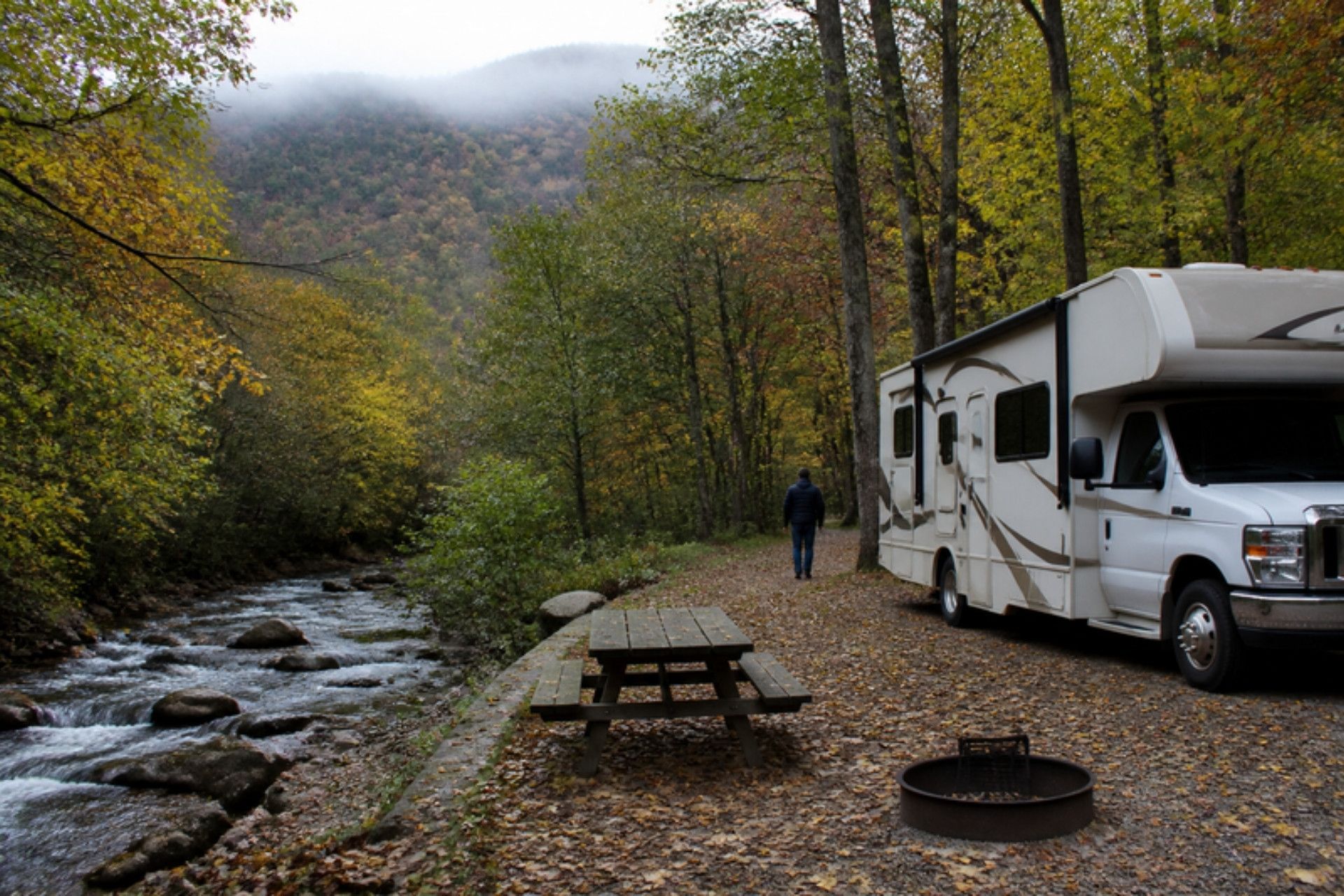
Campgrounds along the Blue Ridge Parkway, near Asheville, Boone, and Blowing Rock, present a distinctive set of risks. Sloped and uneven sites increase the likelihood of guests stumbling on leveling equipment or rocky ground, and wet leaves on steps become a slip hazard during autumn visits. Falling limbs from mature hardwoods are a regular cause of comprehensive claims involving damaged roofs, awnings, and air conditioning units.
Mountain driving also places strain on brakes and transmissions during long descents. Mechanical breakdown is generally not covered by standard physical damage, so owners who travel the mountains regularly may wish to discuss extended service contracts separately, along with roadside assistance capable of towing a large unit up a narrow switchback.
Coastal Coverage for the Outer Banks
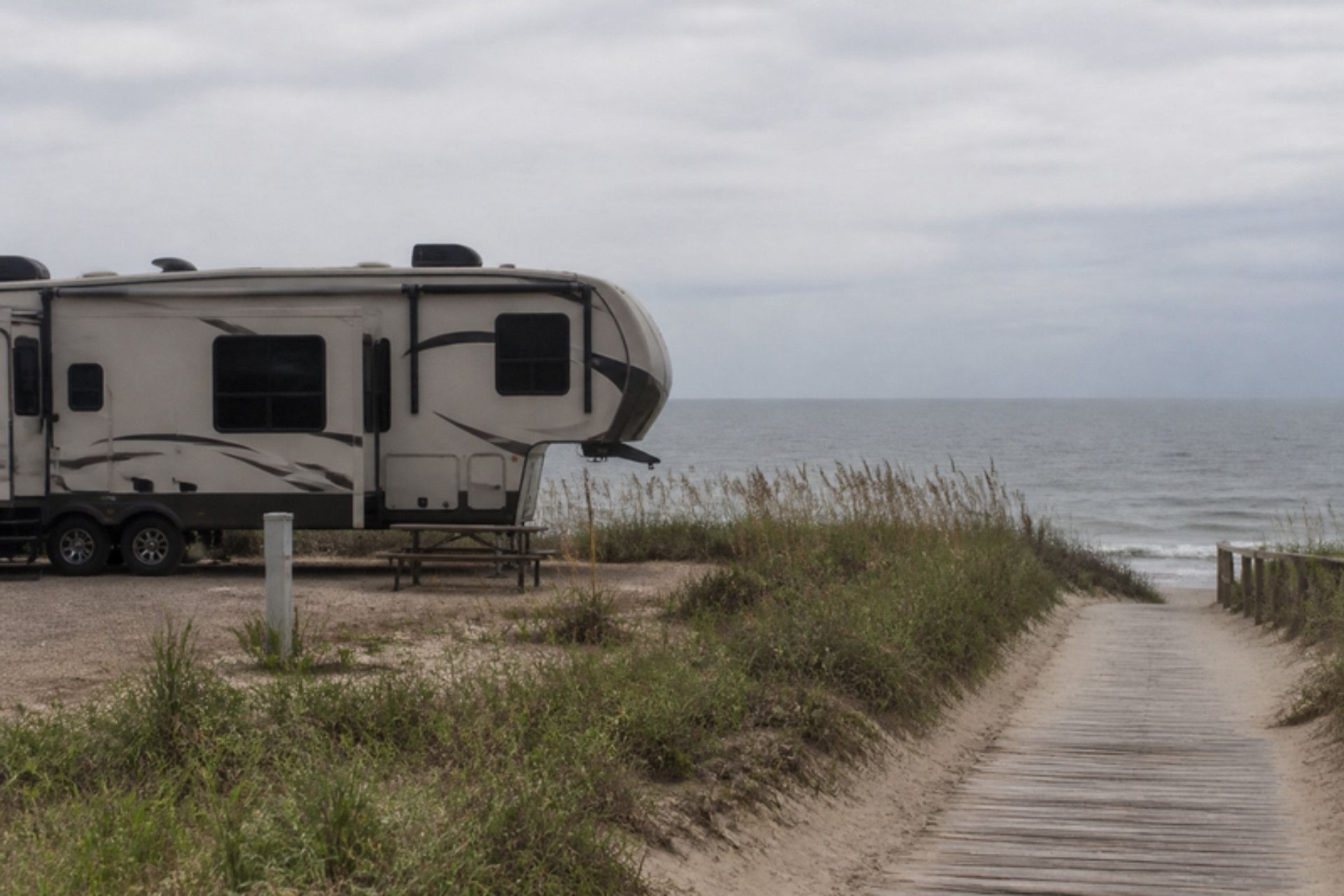
Campgrounds on the Outer Banks, from Kitty Hawk to Ocracoke, carry exposures tied to wind, water, and salt. Hurricane season brings evacuation orders, and owners should understand how comprehensive coverage responds to flooding, storm surge, and windblown debris. Some carriers may restrict binding new coverage once a named storm approaches, so policies should be in place well before late summer.
Sand and salt air can accelerate corrosion, which is usually treated as wear and tear rather than a covered loss. Crowded summer campgrounds also increase foot traffic around the site, making vacation liability especially relevant when children and neighbors gather near an extended awning or outdoor grill.
Comparing RV Coverage Options
Basic auto-style coverage and specialized RV coverage can look similar on a quote summary, yet they diverge significantly after a total loss or a theft. The table below compares how each approach typically handles common situations, although exact terms depend on the carrier and policy form.
| Feature | Basic Auto-Style Coverage | Specialized RV Coverage |
|---|---|---|
| Total loss settlement | Actual cash value, reduced by depreciation | Replacement cost or agreed value options, often for newer units |
| Personal belongings | Limited or excluded | Personal effects coverage with selectable limits |
| Campsite liability | Generally not included | Vacation or full-timer liability available |
| Emergency lodging | Rarely included | Emergency expense coverage commonly offered |
| Attached accessories | May be limited | Awnings, satellite dishes, and solar panels often addressed |
| Roadside assistance | Sized for passenger vehicles | Heavy-vehicle towing and RV-specific service |
| Full-time residence use | Not designed for this | Full-timer endorsement available |
The gap in total loss settlement is often the most expensive surprise. A two-year-old travel trailer purchased for a substantial sum may be valued well below its purchase price under actual cash value, leaving the owner with a loan balance exceeding the settlement. Replacement cost provisions, where available, are designed to close that gap for qualifying units.
Personal effects coverage deserves attention as well. A typical RV may contain bikes, kayaks, laptops, fishing equipment, and cookware, and a theft or fire at a campground can quickly add up to a five-figure loss that an auto-style policy simply does not contemplate.
Specialized Protection for High Net Worth Owners
Owners of luxury Class A diesel pushers, custom conversions, or collectible vintage campers may need protection beyond standard RV forms. Cincinnati and Hagerty are carriers that may offer coverage suited to high-value assets, with features that can include agreed value settlements and broader protection designed for owners of significant personal property.
A high-end motorhome can represent an investment comparable to a primary residence, and its owner frequently holds other valuable assets such as multiple homes, watercraft, and collectible vehicles. Cincinnati is known for private client programs that may coordinate coverage across homes, vehicles, and personal liability. Hagerty is widely associated with collector vehicles and may be a fit for restored vintage trailers and classic motorhomes, depending on eligibility guidelines.
For owners in this category, several considerations typically come into focus:
- Agreed value: Establishing the unit's value at policy inception rather than debating depreciation after a loss.
- Higher liability limits: Coordinated with a personal umbrella to protect accumulated wealth.
- Custom equipment: Documentation of upgrades, appliances, and electronics added after purchase.
- Storage conditions: Climate-controlled or secured storage may influence eligibility and pricing.
Underwriting for high-value units tends to be more detailed, often requiring photographs, appraisals, or receipts. Assembling that documentation in advance generally produces a smoother application and a more accurate valuation.
Why Work with an Independent North Carolina Agent?
An independent agency such as O'Connor Insurance Associates represents multiple carriers, allowing RV owners to compare coverage forms, endorsements, and pricing side by side. Going direct to one insurer limits options to that company's products, while an independent agent can match each unit and usage pattern with an appropriate carrier.
RV policies vary more between carriers than many owners expect. One insurer may offer strong full-timer provisions but limited replacement cost eligibility, while another may excel with towables yet restrict coverage for older motorhomes. An independent agent who works with several companies can identify those differences before a claim reveals them.
Located in Charlotte since 2000 and recognized by the Independent Insurance Agents & Brokers of America (IIABA) as a Best Practices Agency since 2010, O'Connor Insurance Associates emphasizes asking questions and educating clients rather than presenting a single preassembled package. That educational approach is particularly useful for RV owners, whose needs shift depending on whether the unit is towed or driven, used seasonally or lived in, and parked in the mountains or on the coast.
Coordination is another advantage. An agent who also handles a client's auto, homeowners, and umbrella coverage can confirm that liability limits align across policies, that the tow vehicle carries appropriate limits, and that no gaps exist between the homeowners policy and the RV's vacation liability.
Frequently Asked Questions About North Carolina RV Insurance
Do I need separate insurance for my pull-behind trailer?
Liability usually extends from the tow vehicle while the trailer is hitched and moving. Physical damage to the trailer, personal belongings inside it, and campsite liability generally require a separate trailer policy.
Does my car insurance cover my RV?
A personal auto policy may provide limited liability for a towed trailer, but it is not designed to cover a motorhome or the contents and campsite exposures of any RV. A dedicated RV policy is the appropriate solution.
What happens if my RV is stolen at a campground?
Comprehensive coverage typically responds to theft of the unit itself, subject to the deductible. Belongings inside are covered only if the policy includes personal effects coverage, so that limit should be reviewed before travel.
Can I suspend coverage while my RV is in winter storage?
Some carriers allow storage options that reduce road coverage while keeping comprehensive in place. Owners of registered motorhomes should confirm how any change affects state liability requirements before adjusting coverage.
Is hurricane damage on the Outer Banks covered?
Comprehensive coverage generally addresses wind and flood damage to the RV, but binding restrictions may apply once a named storm is approaching. Securing coverage well ahead of hurricane season is the prudent approach.
Do full-timers need a homeowners policy?
Full-timers who no longer own a home typically rely on a full-timer endorsement to replace homeowners-style liability. Without it, many everyday incidents at the campsite may go uncovered.
Making the Right Choice for Your Journey
Every RV owner faces a slightly different combination of exposures, which is why a thoughtful review matters more than a quick quote. A motorhome requires its own liability at or above the 50/100/50 state minimums, while a travel trailer depends on the tow vehicle for road liability and on its own policy for physical damage and campsite protection. Full-time residents need endorsements that replace homeowners coverage, and seasonal campers benefit from vacation liability that follows them from Blue Ridge overlooks to Outer Banks dunes.
High-value units may warrant carriers such as Cincinnati or Hagerty, and every owner benefits from comparing settlement terms, personal effects limits, and emergency expense provisions before signing. Reviewing these choices once a year, or whenever usage changes, keeps the program aligned with how the RV is actually used.
O'Connor Insurance Associates is a licensed North Carolina insurance agency (license #7014004), serving families throughout Highland Creek, Cornelius, Huntersville, Concord, and Harrisburg. RV owners seeking a side-by-side comparison of carriers can contact the Charlotte office at 1973 JN Pease Place, Suite 203, Charlotte, North Carolina 28262, or call 704-510-8884 to schedule a coverage review before the next trip begins.
Coverage descriptions are general. Policy terms, exclusions, limits and underwriting determine coverage.
Last updated:
On this page
O’Connor Insurance Associates is fully licensed to provide personal and commercial insurance solutions for individuals, families and businesses across North Carolina.
We proudly serve families and business owners from our office in Charlotte, North Carolina. As an independent, family-owned agency since 2000, our team works with more than one insurance company to make sure homeowners, drivers, contractors, landscapers, small businesses and other personal and commercial clients receive coverage that fits their real risks.

About the Author
President & Founder
I’m Terry O’Connor, President and Founder of O’Connor Insurance Associates. I grew up in Pennsylvania, earned my bachelor’s degree at Edinboro University and my master’s at Gannon University, and in 1998 I traded snow for sunshine and moved to Charlotte. In January 2000, I started this agency on my own because I wanted to help people protect what matters most to them. More than two decades later, we’ve grown into an independent agency serving families and businesses across North Carolina, and we’ve been recognized as an IIABA Best Practices Agency every year since 2010, a distinction held by fewer than 1% of agencies nationwide.
I’ve seen firsthand how the right protection can change a family’s or a business owner’s life, and that’s why I lead with empathy, education and honest advice. As an independent agent, I work for you, not for one insurance company. I take the time to explain your options in plain language, and when you call our office, you reach a real person who knows your account.
Outside the office, you’ll usually find me outdoors hunting or fishing, or on the mat coaching wrestling as an assistant varsity coach at Mallard Creek High School. I’m also a proud supporter of the arts, usually in the front row cheering on my daughter in local theater productions. I’d be glad to review your coverage with you. Call me at 704-510-8884 or email terry@oianc.com.
Relationships are the real measure
What our North Carolina clients say.
5.0 / 5
185 reviews on Google
Personal insurance
For the life you’re making.
Your home, your car, your time away. Let’s look at the whole picture.
Business insurance
For the business you’re building.
From established local companies to growing teams, we help make the coverage conversation clearer.
Your work deserves a closer look
Different businesses.
Different conversations.
We take time to understand what happens in your business every day.

Landscaping

Manufacturers

Technology Companies

HVAC Insurance

Electricians Insurance

Food Manufacturers
A little clarity goes a long way
Good questions.
Straight answers.
Have something else on your mind?
What does an independent insurance agency do?
An independent agency helps you compare options from more than one insurance company. We start with your needs, explain the differences and help you make an informed decision.
What can O’Connor help me insure?
Our team works with personal and business insurance, life and disability coverage, and Medicare options. Tell us what you need, and we’ll connect you with the right person.
Where does your agency serve clients?
We are based in Charlotte and serve clients across North Carolina. If your business operates in more than one state, call us to discuss your locations and coverage needs.
How do I get an insurance quote?
Start with the contact form or call 704-510-8884. We’ll ask about your situation and any current coverage, then review available options. Submitting a request does not bind coverage.
Can you help with an existing policy or claim?
Yes. Our Client Center page connects you with policy service, billing and claims options. You can also call during office hours for help finding the right next step.
What should I know before switching insurance?
Compare coverage, limits, exclusions and effective dates, not just the price. Speak with your agent before canceling an existing policy so you can coordinate the transition.
From our desk to yours
A little knowledge goes a long way.



Get a Quote
Let’s protect what you’re building.
Tell us a little about yourself. We’ll help you take the next step with a clearer picture of your options.
1973 J.N. Pease Place, Suite 203
Charlotte, NC 28262
Monday–Thursday · 9 AM–5 PM
Friday · 9 AM–3 PM
